Natural History
Banksia sphaerocarpa
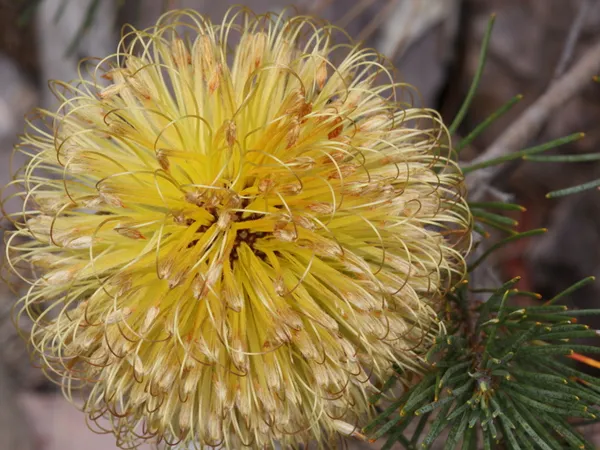
Banksia sphaerocarpa, commonly known as the fox banksia or round-fruit banksia, is a species of shrub or tree in the plant genus Banksia (family Proteaceae). It is generally encountered as a 1–2 m (3.3–6.6 ft) high shrub, and is usually smaller in the north of its range. This species has narrow green leaves, and brownish, orange or yellow round flower spikes which may be seen from January to July. It is widely distributed across the southwest of Western Australia, growing exclusively in sandy soils. It is usually the dominant plant in scrubland or low woodland. It is pollinated by, and is a food source for, birds, mammals, and insects. First described in 1810 by botanist Robert Brown, B. sphaerocarpa has a complicated taxonomic history, and several taxa once classified as part of a broadly defined B. sphaerocarpa have since been named as species in their own right. At present, most authorities recognise five varieties; the largest variety, B. sphaerocarpa var. dolichostyla (ironcap banksia), is sometimes given species rank as B. dolichostyla. B. sphaerocarpa is classified as Not Threatened under the Wildlife Conservation Act of Western Australia, although two varieties have been placed on the Declared Rare and Priority Flora List—var. latifolia has been designated a Priority Two – Poorly Known taxon, and var. dolichostyla falls under Declared Rare Flora. None of the varieties are commonly seen in cultivation.
Also on this shelf
Agroforestry.
Least weasel.
See also
Uncatalogued shelfText from Wikipedia; plate via Wikimedia Commons. Text CC BY-SA 4.0; plate freely licensed (see Commons). Source record. Images and catalogue data are reproduced from open-access collections.