Natural History
Fossil Butte National Monument
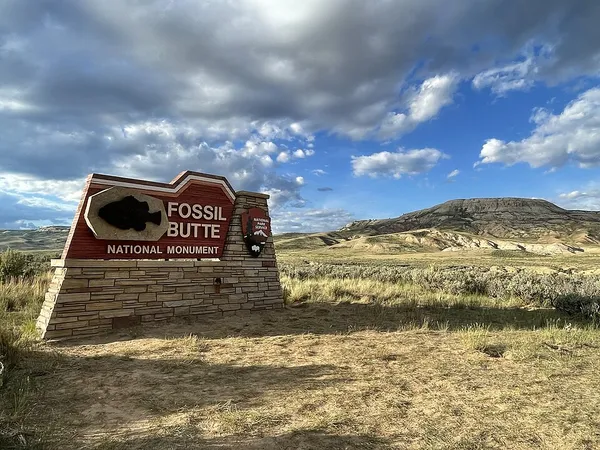
Fossil Butte National Monument is a United States National Monument managed by the National Park Service, located 15 miles (24 km) west of Kemmerer, Wyoming, United States. It centers on an assemblage of Eocene Epoch (56 to 34 million years ago) animal and plant fossils associated with Fossil Lake—the smallest lake of the three great lakes which were then present in what are now Wyoming, Utah, and Colorado. The other two lakes were Lake Gosiute and Lake Uinta. Fossil Butte National Monument was established as a national monument on October 23, 1972. Fossil Butte National Monument preserves the best paleontological record of Cenozoic aquatic communities in North America and possibly the world, within the 50-million-year-old Green River Formation — the ancient lake bed. Fossils preserved include fish, alligators, bats, turtles, a dog-sized horse, insects, and many other species of plants and animals — suggest that the region was a low, subtropical, freshwater basin when the sediments accumulated, over about a 2 million-year period.
Also on this shelf
Gunung Mulu National Park.
Hiiumaa.
See also
Uncatalogued shelfText from Wikipedia; plate via Wikimedia Commons. Text CC BY-SA 4.0; plate freely licensed (see Commons). Source record. Images and catalogue data are reproduced from open-access collections.