Natural History
Cloud forest
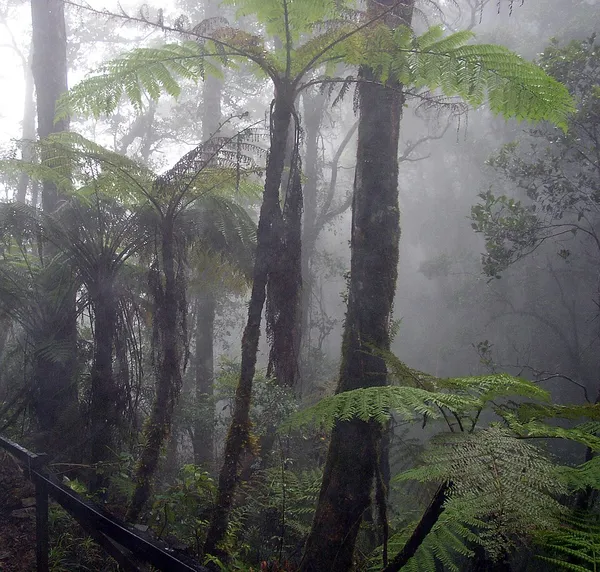
A cloud forest, also called a water forest, primas forest, or tropical montane cloud forest, is a generally tropical or subtropical, evergreen, montane, moist forest characterized by a persistent, frequent or seasonal low-level cloud cover, usually at the canopy level, formally described in the International Cloud Atlas (2017) as silvagenitus. Cloud forests often exhibit an abundance of mosses covering the ground and vegetation, in which case they are also referred to as mossy forests. Mossy forests usually develop on the saddles of mountains, where moisture introduced by settling clouds is more effectively retained. This ecosystem is rare globally, but its natural beauty, moderate climate, and easy accessibility makes it highly attractive for tourism. The presence and history of colonial hill stations, and the allure of ecotourism and adventure travel, have also contributed to a degree of romanticization. Cloud forests form under a variety of conditions, one of which involves winds carrying moisture-laden air against mountain slopes, causing the air to rise and cool through orographic lift until it condenses into persistent low clouds. This mechanism sustains the characteristically high humidity that defines the biome and sets it apart from other montane forest types. These forests are among the most biodiversity-rich biomes in the world, harboring a disproportionately large number of endemic plant and animal species that depend on the stable, moist microclimate they provide. They also play a critical role in regional hydrology: fog drip, condensation that forms on foliage and drips to the ground, can supplement annual precipitation substantially, making cloud forests vital freshwater sources for downstream communities and ecosystems. Despite their ecological importance, cloud forests are under threat from deforestation, agricultural encroachment, and climate change. Approximately 2.4% of global cloud forest cover was lost between 2001 and 2018, with losses in some regions exceeding 8%. Because cloud formation is tightly linked to local temperature and atmospheric conditions, rising global temperatures are projected to push optimal cloud forest climates to higher elevations, effectively shrinking available habitat over the coming decades.
Also on this shelf
African striped weasel.
Fauna of Great Britain.
See also
Uncatalogued shelfText from Wikipedia; plate via Wikimedia Commons. Text CC BY-SA 4.0; plate freely licensed (see Commons). Source record. Images and catalogue data are reproduced from open-access collections.