Natural History
Brown bear
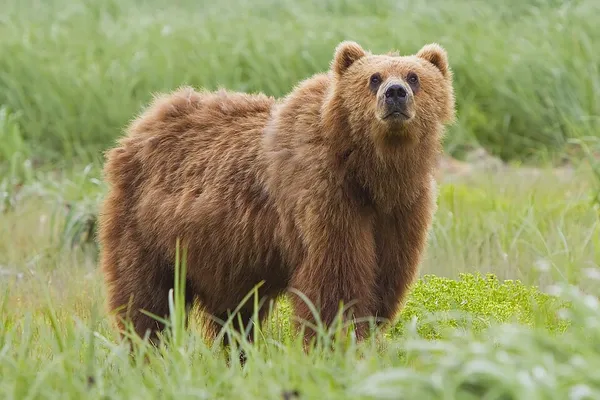
The brown bear (Ursus arctos) is a large bear native to Eurasia and North America. Of the land carnivorans, it is rivaled in size only by its closest relative, the polar bear, which is much less variable in size and slightly bigger on average. The brown bear is a sexually dimorphic species, as adult males are larger and more compactly built than females. The fur ranges in color from cream to reddish to dark brown. It has evolved large hump muscles, unique among bears, and paws up to 21 cm (8.3 in) wide and 36 cm (14 in) long, to effectively dig through dirt. Its teeth are similar to those of other bears and reflect its dietary plasticity. Throughout the brown bear's range, it inhabits mainly forested habitats in elevations of up to 5,000 m (16,000 ft). It is omnivorous, and consumes a variety of plant and animal species. Contrary to popular belief, the brown bear derives 90% of its diet from plants. When hunting, it will target animals as small as insects and rodents to those as large as moose or muskoxen. In parts of coastal Alaska, brown bears predominantly feed on spawning salmon that come near shore to lay their eggs. For most of the year, it is a usually solitary animal that associates only when mating or raising cubs. Females give birth to an average of one to three cubs that remain with their mother for 1.5 to 4.5 years. It is a long-lived animal, with an average lifespan of 25 years in the wild. Attacks on humans, though widely reported, are generally rare. While the brown bear's range has shrunk, and it has faced local extinctions across its wide range, it remains listed as a least concern species by the International Union for Conservation of Nature (IUCN) with a total estimated population in 2017 of 110,000. Populations that were hunted to extinction in the 19th and 20th centuries are the Atlas bear of North Africa and the Californian, Ungavan and Mexican populations of the grizzly bear of North America. Many of the populations in the southern parts of Eurasia are highly endangered as well. One of the smaller-bodied forms, the Himalayan brown bear, is critically endangered: it occupies only 2% of its former range and is threatened by uncontrolled poaching for its body parts.
Also on this shelf
Caddo Lake State Park.
Cooper State Park.
See also
Uncatalogued shelfText from Wikipedia; plate via Wikimedia Commons. Text CC BY-SA 4.0; plate freely licensed (see Commons). Source record. Images and catalogue data are reproduced from open-access collections.