Natural History
Amazon basin
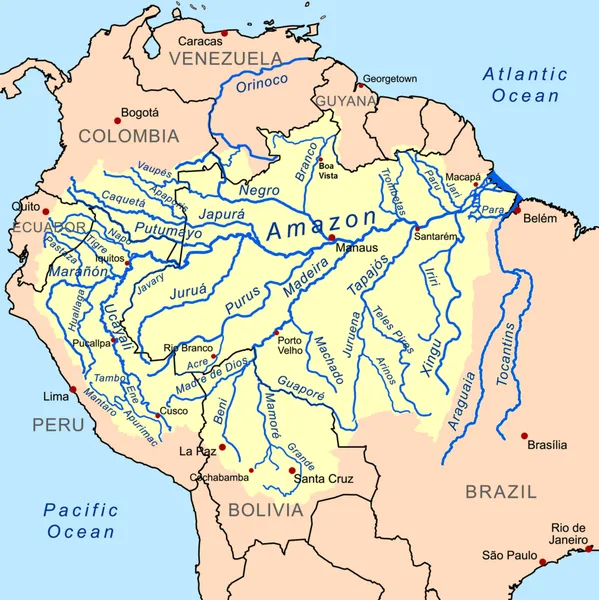
The Amazon basin is the part of South America drained by the Amazon River and its tributaries. The Amazon drainage basin covers a large area spreading across the countries of Bolivia, Brazil, Colombia, Ecuador, Guyana, Peru, Suriname, and Venezuela, as well as the territory of French Guiana. Most of the basin is covered by the Amazon rainforest, also known as Amazonia. With a 6 million km2 (2.3 million mi2) area of dense tropical forest, it is the largest rainforest in the world. The Amazon basin is the most biodiverse region in the world, being home to many of the Earth's plant, mammal, bird, reptile, amphibian, fish and insect species. While being very biodiverse the majority of the Amazon basin is sparsely populated by humans with the exceptions of cities such as Manaus and Belém. There are many indigenous communities who represent many different cultures and languages. For the people living in the Amazon basin fishing and agriculture are a very important livelihood.
Also on this shelf
Eastern cottontail.
Fork-tailed storm petrel.
See also
Uncatalogued shelfText from Wikipedia; plate via Wikimedia Commons. Text CC BY-SA 4.0; plate freely licensed (see Commons). Source record. Images and catalogue data are reproduced from open-access collections.