Natural History
Barred owl
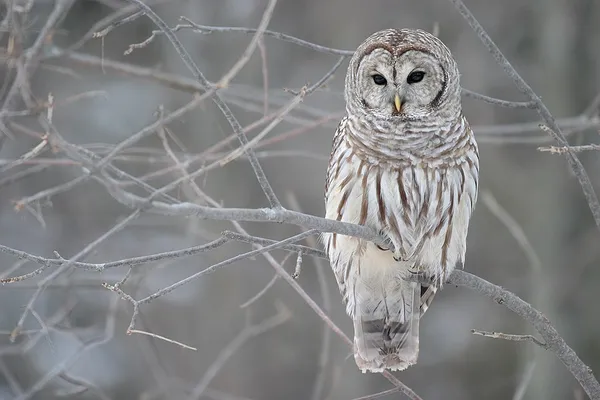
The barred owl (Strix varia), also known as the northern barred owl, striped owl, or more informally, hoot owl or eight hooter, is a North American large species of owl. A member of the true owl family, Strigidae, they belong to the genus Strix, which is also the origin of the family's name under Linnaean taxonomy. Barred owls are largely native to eastern North America, but have expanded their range to the West Coast of North America, where they are considered invasive. Mature forests are their preferred habitat, but they can also acclimate to various gradients of open woodlands. Their diet consists mainly of small mammals, but this species is an opportunistic predator and is known to prey upon other small vertebrates such as birds, reptiles, and amphibians, as well as a variety of invertebrates. Barred owls are brown to gray overall, with dark striping on the underside. They have typical nesting habits for a true owl, tending to raise a relatively small brood often in a tree hollow or snag (but sometimes also in other nesting sites) in forested areas. As a result of the barred owl's westward expansion, the species has begun to encroach on the range of the related and threatened spotted owl (S. occidentalis). Evidence shows the assorted threats posed by the invading barred species are only increasing. In response, biologists have recommended culling operations to mitigate their negative effect on the spotted owl species.
Also on this shelf
Anza-Borrego Desert State Park.
Asian golden cat.
See also
Uncatalogued shelfText from Wikipedia; plate via Wikimedia Commons. Text CC BY-SA 4.0; plate freely licensed (see Commons). Source record. Images and catalogue data are reproduced from open-access collections.