Natural History
Crown group
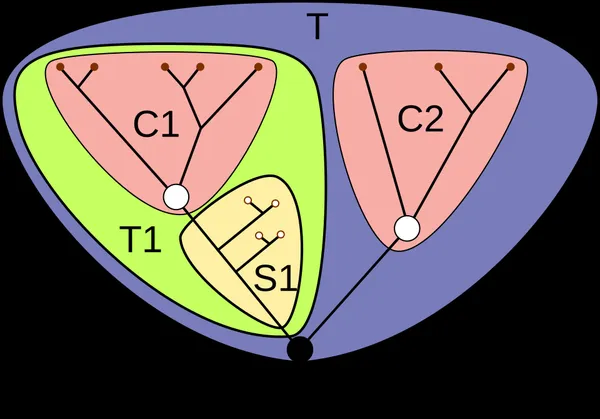
In phylogenetics, the crown group, crown clade, or crown assemblage is a collection of species composed of the living representatives of the collection, the most recent common ancestor of the collection, and all descendants of the most recent common ancestor. It is thus a way of defining a clade, a group consisting of a species and all its extant or extinct descendants. For example, Aves (birds) can be defined as a crown group, which includes the most recent common ancestor of all modern birds, and all of its extant or extinct descendants. The concept was developed by Willi Hennig, the formulator of phylogenetic systematics, as a way of classifying living organisms relative to their extinct relatives in his "Die Stammesgeschichte der Insekten", and the "crown" and "stem" group terminology was coined by R. P. S. Jefferies in 1979. Though formulated in the 1970s, the term was not commonly used until its reintroduction in 2000 by Graham Budd and Sören Jensen.
Also on this shelf
Carnegie Museum of Natural History.
Environmental issues in Puget Sound.
See also
Uncatalogued shelfText from Wikipedia; plate via Wikimedia Commons. Text CC BY-SA 4.0; plate freely licensed (see Commons). Source record. Images and catalogue data are reproduced from open-access collections.