Natural History
Extinction risk from climate change
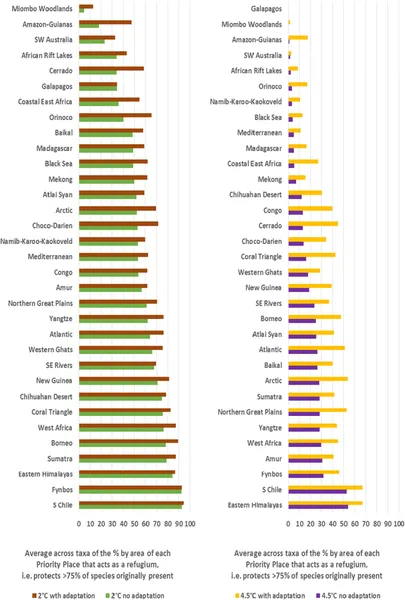
There are several plausible pathways that could lead to plant and animal species extinction from climate change. Every species has evolved to exist within a certain ecological niche, but climate change leads to changes of temperature and average weather patterns. These changes can push climatic conditions outside of the species' niche, and ultimately render it extinct. Normally, species faced with changing conditions can either adapt in place through microevolution or move to another habitat with suitable conditions. However, the speed of recent climate change is very fast. Due to this rapid change, for example cold-blooded animals (a category which includes amphibians, reptiles and all invertebrates) may struggle to find a suitable habitat within 50 km of their current location at the end of this century (for a mid-range scenario of future global warming). Climate change also increases both the frequency and intensity of extreme weather events, which can directly wipe out regional populations of species. Those species occupying coastal and low-lying island habitats can also become extinct by sea level rise. This has already happened with Bramble Cay melomys in Australia, which was the first mammal to go extinct due to human-induced sea level rise, with the Australian government officially confirming its extinction in 2019. Climate change has been linked with the increased prevalence and global spread of infectious diseases affecting wildlife. This includes Batrachochytrium dendrobatidis, a fungus that is one of the main drivers of the worldwide decline in amphibian populations. So far, climate change has not yet been a major contributor to the ongoing holocene extinction. In fact, nearly all of the irreversible biodiversity loss to date has been caused by other anthropogenic pressures such as habitat destruction. Yet, its effects are certain to become more prevalent in the future. As of 2021, 19% of species on the IUCN Red List of Threatened Species are already being impacted by climate change. Out of 4000 species analyzed by the IPCC Sixth Assessment Report, half were found to have shifted their distribution to higher latitudes or elevations in response to climate change.
Also on this shelf
Corn snake.
Askham Bog.
See also
Uncatalogued shelfText from Wikipedia; plate via Wikimedia Commons. Text CC BY-SA 4.0; plate freely licensed (see Commons). Source record. Images and catalogue data are reproduced from open-access collections.