Natural History
Bovine anatomy
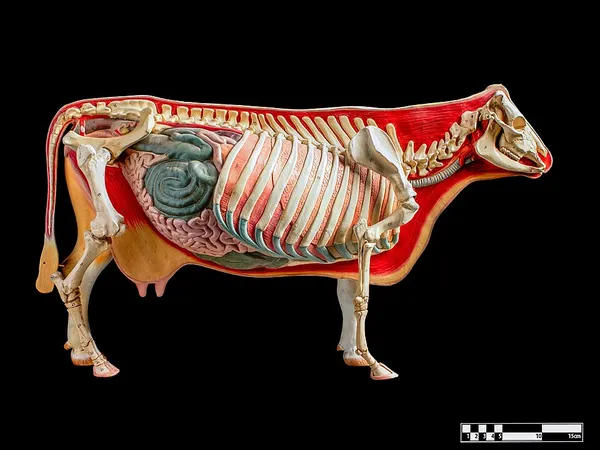
Bovine anatomy is the study of gross and microscopic anatomical structures in members of Bovidae, which include cattle, goats, bison, and antelopes. Being mammals, bovids are warm-blooded and have fur, and are placental mammals (as opposed to marsupials or monotremes). Bovids are also ruminants, and except for some polled domestic breeds, all male bovids have keratin-coated horns. Many female bovids have horns as well. Bovids vary greatly in size, weight, color, and horn shape. The smallest wild bovid is the royal antelope, which stands at 25 cm (10 in) and has an average weight of 2 kg (4.4 lb). The largest is the gaur, which stands at 1.8 m (6 feet) and can weigh over 900 kg (1984.2 lb). The selective breeding of domestic cattle has led to especially great variations within that species. The smallest cattle breed is the Vechur, which reaches a maximum size of 83-105 cm (32-41 in) and maximum weight of 130-200 kg (286-440 lb), while the largest, the Chianina, can reach a height of 2 meters (6.6 feet) and weight of 1,600 kg (35,723 lb), or 1.6 tonnes. There is more disparity among the bovids than among other ruminants.
Also on this shelf
Geography of Papua New Guinea.
Greater rhea.
See also
Uncatalogued shelfText from Wikipedia; plate via Wikimedia Commons. Text CC BY-SA 4.0; plate freely licensed (see Commons). Source record. Images and catalogue data are reproduced from open-access collections.