Natural History
Geography and ecology of the Everglades
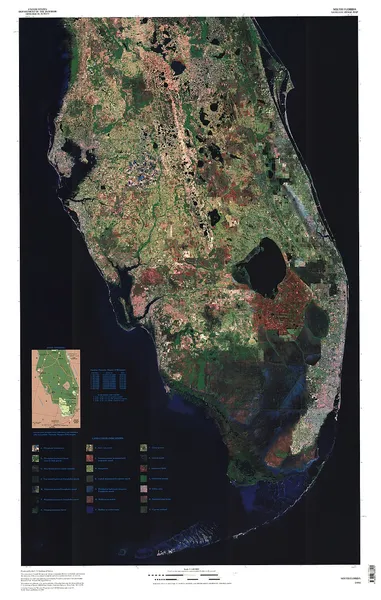
The Everglades is both a vast watershed in southern Florida and many interconnected tropical wetlands ecosystems within a geographic boundary. Formed about 5,000 years ago, it has historically covered around one-third of the southern Florida peninsula, from Lake Okeechobee 100 miles (160 km) south to Florida Bay. Before drainage, its interwoven mesh of marshes and prairies covered 4,000 square miles (10,000 km2). It is such a unique meeting of water, land, and climate that the use of either singular or plural to refer to the Everglades is appropriate. When Marjory Stoneman Douglas wrote her definitive description of the region in 1947, she used the metaphor "River of Grass" to explain the blending of water and plant life. Although sawgrass and sloughs are the enduring geographical icons of the Everglades, other ecosystems are just as vital, and the borders marking them are subtle or nonexistent. Pinelands and tropical hardwood hammocks are located throughout the sloughs; the trees, rooted in soil inches above the peat, marl, or water, support a variety of wildlife. The oldest and tallest trees are cypresses, whose roots are specially adapted to grow underwater for months at a time. The Big Cypress Swamp is well known for its 500-year-old cypresses, though cypress domes can appear throughout the Everglades. As the freshwater from Lake Okeechobee makes its way to Florida Bay, it meets saltwater from the Gulf of Mexico; mangrove forests grow in this transitional zone, providing nursery and nesting conditions for many species of birds, fish, and invertebrates. The marine environment of Florida Bay is also considered part of the Everglades because its seagrasses and aquatic life are attracted to the constant discharge of freshwater. These ecological systems are always changing due to environmental factors. Geographic features such as the Western Flatwoods, Eastern Flatwoods, and Atlantic Coastal Ridge affect drainage patterns. Geologic elements, climate, and the frequency of storms and fire are formative processes for the Everglades. They help to sustain and transform the ecosystems in the Shark River Valley, Big Cypress Swamp, coastal areas, and mangrove forests. Ecosystems have been described as both fragile and resilient.
Also on this shelf
Australian green tree frog.
Gugh.
See also
Uncatalogued shelfText from Wikipedia; plate via Wikimedia Commons. Text CC BY-SA 4.0; plate freely licensed (see Commons). Source record. Images and catalogue data are reproduced from open-access collections.