Natural History
Appalachia (landmass)
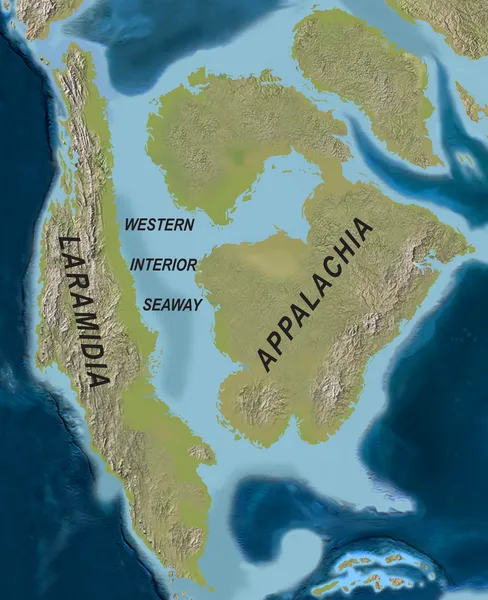
During most of the Late Cretaceous (100.5 to 66 million years ago) the eastern half of North America formed Appalachia (named for the Appalachian Mountains), an island land mass separated from Laramidia to the west by the Western Interior Seaway, and from Hudsonia by the Hudson Seaway. This seaway had split North America into two massive landmasses due to a multitude of factors such as tectonism and sea-level fluctuations for nearly 40 million years. The seaway eventually expanded, divided across the Dakotas, and by the end of the Cretaceous, it retreated towards the Gulf of Mexico and the Hudson Bay. This left the island masses joined in the continent of North America as the Rocky Mountains rose. From the Cenomanian to the end of the Campanian ages of the Late Cretaceous, Appalachia was separated from the rest of North America. As the Western Interior Seaway retreated in the Maastrichtian, Laramidia and Appalachia eventually connected. Until this connection, its fauna was isolated, and developed very differently from the tyrannosaur, ceratopsian, hadrosaurid, pachycephalosaur and ankylosaurid dominated fauna of the western part of North America, known as "Laramidia". Due to high sea levels, subsequent erosion, and the lack of orogenic input of sediment into the Western Interior Seaway unlike the east coast of Laramidia, no terrestrially formed deposits have survived, with most dinosaur remains originating from seaborne carcasses that were transported into marine environments. This same lack of terrestrial sediments is also present on the western coast of Laramidia. Some sediments in the northern part of the range have been removed by glacial erosion of the Laurentide Ice Sheet during Quaternary glaciations, but it is difficult to ascertain how much sediment has been removed, or whether these sediments would have been any more productive than those that remain. Thus relatively little is known about Appalachia in comparison to Laramidia, with the exception of plant life, marine life and the insects trapped in amber from New Jersey. In addition, due to a lack of interest in Appalachia, many fossils that have been found in Appalachia lie unstudied and remain in the inaccurate genera to which they were assigned in the days of E. D. Cope and O. C. Marsh.
Also on this shelf
American alligator.
Guadalajara Zoo.
See also
Uncatalogued shelfText from Wikipedia; plate via Wikimedia Commons. Text CC BY-SA 4.0; plate freely licensed (see Commons). Source record. Images and catalogue data are reproduced from open-access collections.