Natural History
Australopithecus africanus
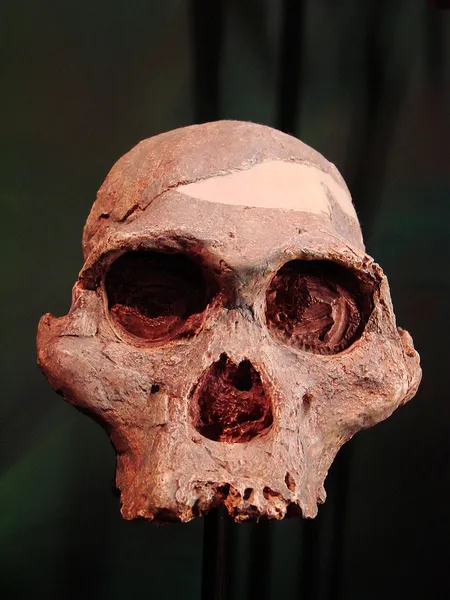
Australopithecus africanus is an extinct species of australopithecine which lived between about 3.3 and 2.1 million years ago in the Late Pliocene to Early Pleistocene of South Africa. The species has been recovered from Taung, Sterkfontein, Makapansgat, and Gladysvale. The first specimen, the Taung child, was described by anatomist Raymond Dart in 1924, and was the first early hominin found. However, its closer relations to humans than to other apes would not become widely accepted until the middle of the century because most had believed humans evolved outside of Africa. It is unclear how A. africanus relates to other hominins, being variously placed as ancestral to Homo and Paranthropus, to just Paranthropus, or to just P. robustus. The oldest known South African australopith specimen "Little Foot", representing the most completely preserved early hominin with 90% of the skeleton intact, has been controversially suggested to represent A. africanus, its probable junior synonym A. prometheus, or neither of the two taxa. A. africanus brain volume was about 420–510 cc (26–31 cu in). Like other early hominins, the cheek teeth were enlarged and had thick enamel. Male skulls may have been more robust than female skulls. Males may have been on average 140 cm (4 ft 7 in) in height and 40 kg (88 lb) in weight, and females 125 cm (4 ft 1 in) and 30 kg (66 lb). A. africanus was a competent biped, albeit less efficient at walking than humans. A. africanus also had several upper body traits in common with arboreal non-human apes. This is variously interpreted as either evidence of a partially or fully arboreal lifestyle, or as a non-functional vestige from a more apelike ancestor. The upper body of A. africanus is more apelike than that of the East African A. afarensis. A. africanus, unlike most other primates, seems to have exploited C4 foods such as grasses, seeds, rhizomes, underground storage organs, or potentially creatures higher up on the food chain. Nonetheless, the species had a highly variable diet, making it a generalist. It may have eaten lower quality, harder foods, such as nuts, in leaner times. To survive, children may have needed nursing during such periods until reaching perhaps 4 to 5 years of age. The species appears to have been patrifocal, with females more likely to leave the group than males. A.
Also on this shelf
Borneo lowland rain forests.
Conservation officer.
See also
Uncatalogued shelfText from Wikipedia; plate via Wikimedia Commons. Text CC BY-SA 4.0; plate freely licensed (see Commons). Source record. Images and catalogue data are reproduced from open-access collections.