Natural History
Amphimerycidae
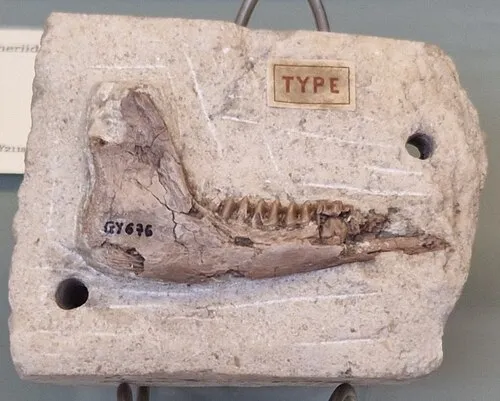
Amphimerycidae is an extinct family of artiodactyls that was endemic to western Europe and lived from the Middle Eocene to the Early Oligocene. With a taxonomic history extending as far back as 1804, the family was formally recognized by the Swiss palaeontologist Hans Georg Stehlin in 1910 and contains two genera: Amphimeryx and Pseudamphimeryx. Species belonging to the Amphimerycidae ranged from 0.4 kg (0.88 lb) to 1.5 kg (3.3 lb), making them among the smallest artiodactyls to have existed. Both amphimerycid genera are very similar to each other in terms of skull and dental anatomy but do have specific differences from each other. Both genera are best known from their fused cuboid bone and navicular bone, which together make up a single "cubonavicular bone" of the hind legs. This trait had long been used in support of the idea that they were ruminants by taxonomists. However, their classification to the Ruminantia had also been rejected by other taxonomists later on due to differences in dentition; the systematic position of the Amphimerycidae and close relatives in relation to the wider Artiodactyla (or Cetartiodactyla), as a result, is unclear. The Amphimerycidae lived in western Europe, which at the time was an archipelago that was isolated from the rest of Eurasia. This meant that it lived in a tropical-subtropical environment with various other faunas that also evolved with strong levels of endemism. Pseudamphimeryx was the first-occurring genus but then was replaced by Amphimeryx in the Late Eocene. Amphimeryx lived up to the Early Oligocene, having apparently briefly survived after the Grande Coupure turnover event.
Also on this shelf
Giant mouse lemur.
Cocos finch.
See also
- ▸"Italy – Costa Rica" Biological Meteo-Climatic Station
- ▸Fort Point Lighthouse (Nova Scotia)
- ▸European wildcat
Text from Wikipedia; plate via Wikimedia Commons. Text CC BY-SA 4.0; plate freely licensed (see Commons). Source record. Images and catalogue data are reproduced from open-access collections.