Natural History
Citipati
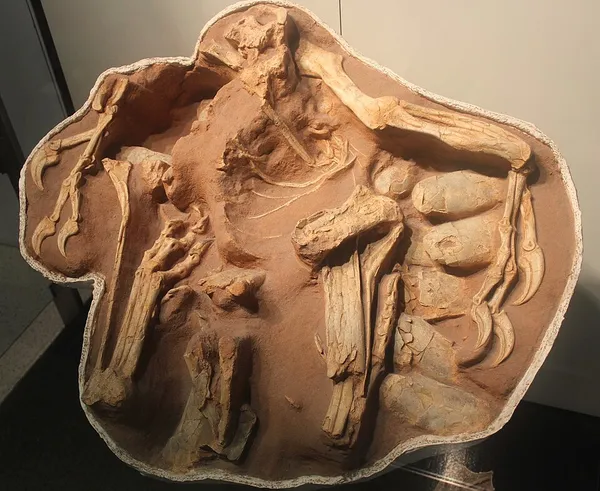
Citipati ([t͡ɕit̪ipɜt̪i]; meaning "funeral pyre lord") is a genus of oviraptorid dinosaur from the Late Cretaceous of Asia, approximately 75 to 71 million years ago. It is primarily known from the Ukhaa Tolgod locality of the Djadochta Formation, where its remains were first collected during the 1990s. The genus and its type species, Citipati osmolskae were formally named and described in 2001. A second species may be represented by remains from the nearby Zamyn Khondt locality. Citipati is among the best-known oviraptorids, owing to several exceptionally preserved specimens, including individuals found in brooding positions over nests of eggs. Many of these fossils were initially assigned to the closely related genus Oviraptor. These nesting specimens have contributed to the understanding of the evolutionary relationship between non-avian dinosaurs and birds. Citipati was among the largest oviraptorids; measuring an estimated 2.5–2.9 m (8.2–9.5 ft) in length and weighing 75–110 kg (165–243 lb). Its skull was short and highly pneumatized, with a prominent crest formed by the premaxilla and nasal bones. Both the upper and lower jaws were toothless and terminated in a horny beak. The tail ended in a pygostyle, a structure formed by the fusion of the final caudal vertebrae and associated with the support of large rectrices. The taxon is classified as an oviraptorid, a group of feathered, bird-like dinosaurs characterized by robust, parrot-like jaws. It is among the oviraptorids known from specimens preserved in the proximity of nests. Citipati laid elongatoolithid eggs in circular, mound-shaped nests, where adults brooded them by sitting over the nest and extending their arms around its perimeter. The arms and tail were covered with long feathers, which may have provided protection for the eggs and young from exposure to the elements. Citipati may have been omnivorous, as the remains of two juvenile troodontid were discovered in a nest, suggesting that they may have been prey brought by an adult Citipati to feed its young..
Also on this shelf
History of Bougainville.
Anastasia Island beach mouse.
See also
Uncatalogued shelfText from Wikipedia; plate via Wikimedia Commons. Text CC BY-SA 4.0; plate freely licensed (see Commons). Source record. Images and catalogue data are reproduced from open-access collections.