Natural History
Global spread of H5N1
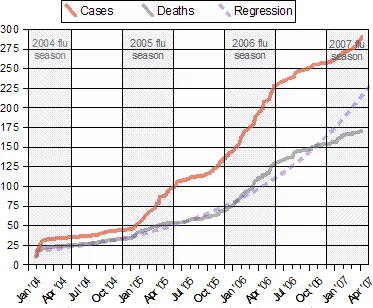
The global spread of H5N1 influenza in birds is considered a significant pandemic threat. While other H5N1 influenza strains are known, they are significantly different on a genetic level from a highly pathogenic, emergent strain of H5N1, which was able to achieve hitherto unprecedented global spread in 2008. The H5N1 strain is a fast-mutating, highly pathogenic avian influenza virus (HPAI) found in multiple bird species. It is both epizootic (an epidemic in non-humans) and panzootic (a disease affecting animals of many species especially over a wide area). Unless otherwise indicated, "H5N1" in this timeline refers to the 2008 highly pathogenic strain of H5N1. Tens of millions of birds have died of H5N1 influenza and hundreds of millions of birds have been slaughtered and disposed of, to limit the spread of H5N1. Countries that have reported one or more major highly pathogenic H5N1 outbreaks in birds (causing at least thousands but in some cases millions of dead birds) are (in order of first outbreak occurrence): South Korea, Vietnam, Japan, Thailand, Cambodia, Laos, Indonesia, China, Malaysia, Russia, Kazakhstan, Mongolia, Turkey, Romania, Croatia, Ukraine, Cyprus, Iraq, Nigeria, Egypt, India, France, Niger, Bosnia, Azerbaijan, Albania, Cameroon, Myanmar, Afghanistan, Israel, Pakistan, Jordan, Burkina Faso, Germany, Sudan, Ivory Coast, Djibouti, Hungary, United Kingdom, Kuwait, Bangladesh, Saudi Arabia, Ghana, Czech Republic, Togo, Nepal, Bhutan, the Philippines, and Chile. Highly pathogenic H5N1 has been found in birds in the wild in numerous other countries: Austria, Belgium, Bulgaria, Denmark, Greece, Iran, Italy, Poland, Serbia and Montenegro, Slovakia, Slovenia, Spain, Sweden, Switzerland, and Uruguay. Surveillance of H5N1 in humans, poultry, wild birds, cats and other animals remains very weak in many parts of Asia and Africa. Much remains unknown about the exact extent of its spread. H5N1 has low pathogenic varieties endemic in birds in North America. H5N1 has a highly pathogenic variety that is endemic in dozens of species of birds throughout south Asia and parts of Africa. So far, it is very difficult for humans to become infected with H5N1.
Also on this shelf
Daniel Boone National Forest.
Forest Park (Portland, Oregon).
See also
Uncatalogued shelfText from Wikipedia; plate via Wikimedia Commons. Text CC BY-SA 4.0; plate freely licensed (see Commons). Source record. Images and catalogue data are reproduced from open-access collections.