Natural History
Divergent evolution
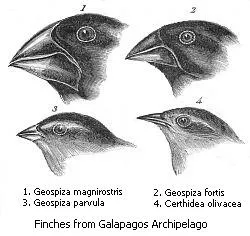
Divergent evolution or divergent selection is the accumulation of differences between closely related populations within a species, sometimes leading to speciation. It can occur when two populations become separated by some barrier (such as physical separation in allopatric or peripatric speciation) and become subject to differing selective pressures and potentially genetic drift. If sufficient evolutionary distance accumulates, the derived populations may become reproductively incompatible through various types of physiological or behavioral barriers. Charles Darwin discussed an early version of the concept at length, but the American naturalist J. T. Gulick (1832–1923) was the first to use the term "divergent evolution" specifically, and it has since become a foundational concept in evolutionary biology. Examples of divergence in nature are the adaptive radiation of the finches of the Galápagos, changes in mobbing behavior of the kittiwake, and the evolution of the modern-day dog from the wolf. The term can also be applied in molecular evolution, such as to proteins that derive from homologous sequences in diverged populations. Two or more genes that descend from a single ancestor and reside in diverged populations are said to be orthologs, and those duplicated prior to speciation are said to be paralogs. Paralogs can be further distinguished as alloparalogs (duplicates in the same population) or symparalogs (genes in diverged populations which descend from different alloparalogs in an ancestral population). The degree of divergence between various homologous sequences is a common metric for estimating past divergent selection on them. Importantly, sequence divergence can occur without effects on fitness, thus resulting in drift rather than adaptive divergence, as is the case in silent mutations, some synonymous substitutions, or in stable mutation-selection balance. It is the position of Motoo Kimura's neutral theory and later Tomoko Ohta's nearly neutral theory that the large majority of divergent molecular evolution across the tree of life is effectively neutral with regards to fitness.
Also on this shelf
Egg incubation.
Cowan Lake State Park.
See also
Uncatalogued shelfText from Wikipedia; plate via Wikimedia Commons. Text CC BY-SA 4.0; plate freely licensed (see Commons). Source record. Images and catalogue data are reproduced from open-access collections.