Natural History
Eduardo Avaroa Andean Fauna National Reserve
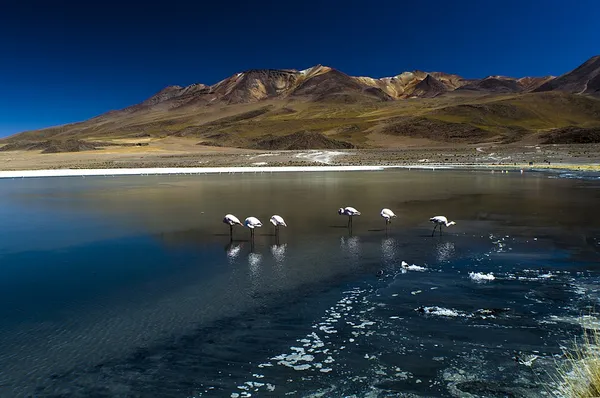
The Eduardo Avaroa Andean Fauna National Reserve (Spanish: Reserva Nacional de Fauna Andina Eduardo Avaroa) is a protected area located in the Sud Lípez province of the Potosí department, in southwestern Bolivia. It lies within the high Altiplano and the Andes Mountains, at altitudes ranging between 4,200 m (13,800 ft) and 5,400 m (17,700 ft). The reserve was officially established in December 1973 and is named after Eduardo Abaroa, a national hero recognized for his role in the War of the Pacific. It is one of Bolivia’s 60 protected areas and is categorized under IUCN Category IV, primarily for the protection of birds that inhabit the different lagoons. In 2018, it attracted approximately 153,000 visitors, making it the most visited protected area in the country. Covering 714,745 hectares, the reserve encompasses one of the most extreme and unique environments of the Bolivian altiplano. It is part of the Central Andean dry puna (oligothermic) ecoregion. Its landscape is predominantly mountainous and desert-like, hosting some of the highest volcanoes in southwestern Bolivia near the borders with Argentina and Chile, including Licancabur, Uturuncu, and Ollagüe. The reserve is also home to Sol de Mañana, a geothermally active area featuring geysers, fumaroles, and hot springs. Notable bodies of water include Laguna Colorada, Laguna Blanca, and Laguna Verde, each distinguished by unique physical, chemical, and color characteristics. The reserve’s ecosystem is nationally significant due to the presence of species adapted to extreme conditions of altitude, temperature, and limited water availability. Mammal species include vicuñas, guanacos, llamas, and Andean foxes. Its high-altitude lakes host three flamingo species: Andean, James’s, and Chilean flamingos.
Also on this shelf
Capsicum.
Charles McCann.
See also
Uncatalogued shelfText from Wikipedia; plate via Wikimedia Commons. Text CC BY-SA 4.0; plate freely licensed (see Commons). Source record. Images and catalogue data are reproduced from open-access collections.