Natural History
Evolution of mammals
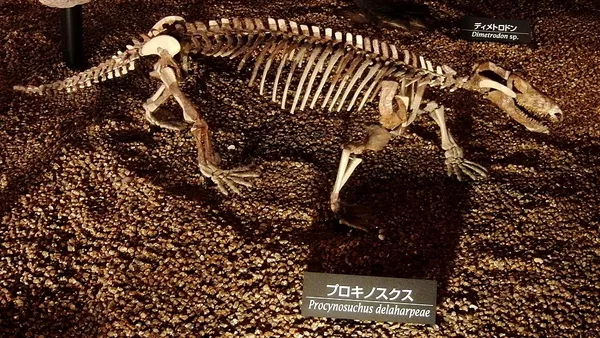
The evolution of mammals has passed through many stages since the first appearance of their synapsid ancestors in the Pennsylvanian sub-period of the late Carboniferous period. By the mid-Triassic, there were many synapsid species that looked like mammals. The lineage leading to today's mammals split up in the Jurassic; synapsids from this period include Dryolestes, more closely related to extant placentals and marsupials than to monotremes, as well as Ambondro, more closely related to monotremes. Later on, the eutherian and metatherian lineages separated; the metatherians are the animals more closely related to the marsupials, while the eutherians are those more closely related to the placentals. Since Juramaia, the earliest known eutherian, lived 160 million years ago in the Jurassic, this divergence must have occurred in the same period. After the Cretaceous–Paleogene extinction event wiped out the non-avian dinosaurs (birds being the only surviving dinosaurs) and several mammalian groups, placental and marsupial mammals diversified into many new forms and ecological niches throughout the Paleogene and Neogene, by the end of which all modern orders had appeared. The synapsid lineage became distinct from the sauropsid lineage in the late Carboniferous period, between 320 and 315 million years ago. The only living synapsids are mammals, while the sauropsids gave rise to today's reptiles; to the dinosaurs, hence in turn to birds; and to all the extinct amniotes more closely related to them than to mammals. Primitive synapsids were traditionally called "mammal-like reptiles" or "pelycosaurs", but both are now seen as outdated and disfavored paraphyletic terms, since they were not reptiles, nor part of reptile lineage. The modern term for these is "stem mammals", and sometimes "protomammals" or "paramammals". Throughout the Permian period, the synapsids included the dominant carnivores and several important herbivores. In the subsequent Triassic period, however, a previously obscure group of sauropsids, the archosaurs, became the dominant vertebrates. The mammaliaforms appeared during this period; their superior sense of smell, backed up by a large brain, facilitated entry into nocturnal niches with less exposure to archosaur predation.
Also on this shelf
Barbary macaques in Gibraltar.
Common slow worm.
See also
Uncatalogued shelfText from Wikipedia; plate via Wikimedia Commons. Text CC BY-SA 4.0; plate freely licensed (see Commons). Source record. Images and catalogue data are reproduced from open-access collections.