Natural History
Gugh
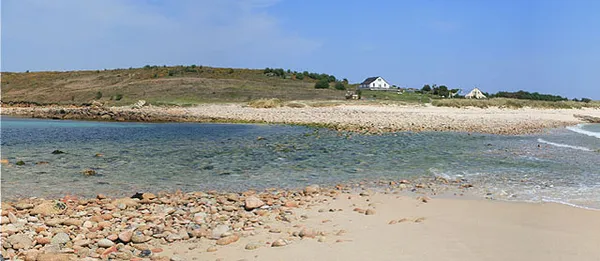
Gugh ( GHEW; Cornish: Keow, lit. 'hedge banks') could be described as the sixth inhabited island of the Isles of Scilly, but is usually included with St Agnes with which it is joined by a sandy tombolo known as "The Bar" when exposed at low tide. The island is only about 1 km (0.62 mi) long and about 0.5 km (0.31 mi) wide, with the highest point, Kittern Hill, at 34 m (112 ft). The geology consists of Hercynian granite with shallow podzolic soils on the higher ground and deeper sandy soils on the lower ground. The former Gugh farm is just north of the neck across the middle of the island between the two hills. The two houses were designed and built in the 1920s by Charles Hamlet Cooper. The island lies within the Isles of Scilly Heritage Coast, is in the Isles of Scilly Area of Outstanding Natural Beauty and is managed by the Isles of Scilly Wildlife Trust. Vegetation cover is mainly wind-pruned heath or dense bracken and bramble with a small area of coastal grassland formed over blown sand which has accumulated near the bar. In 2013, the Isles of Scilly Seabird Recovery Project was set up by a number of organisations including the Royal Society for the Protection of Birds (RSPB) and the Isles of Scilly Wildlife Trust. The five-year project aimed to keep the islands of St Agnes and Gugh free of the brown rat (Rattus norvegicus), in order to assist the survival of breeding sea birds. A programme of habitat restoration began in January 2016 with the removal of the invasive Pittosporum (Crassifolium species).
Also on this shelf
Algonquin Highlands.
African forest elephant.
See also
Uncatalogued shelfText from Wikipedia; plate via Wikimedia Commons. Text CC BY-SA 4.0; plate freely licensed (see Commons). Source record. Images and catalogue data are reproduced from open-access collections.