Natural History
Conus papillaris
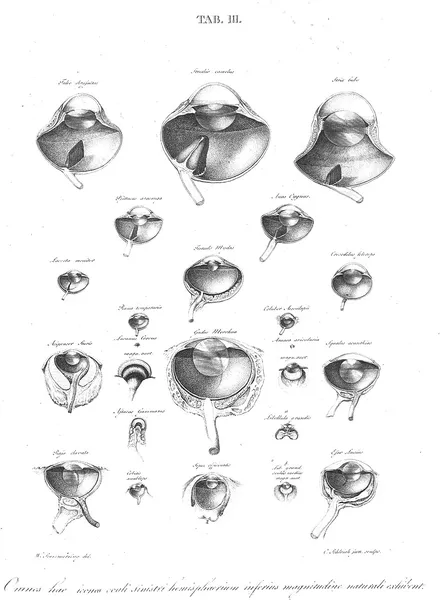
The conus papillaris (Latin for "nipple-like cone") is a feature of the reptilian eye which originates from the ventro-temporal optic nerve head and rises into the vitreous. The cone is vascular (and thus has been also called a conus vascularis). It is homologous to the avian pecten oculi. However, the one in birds is much more elaborate in size and development. Other than blood vessels and connective tissue, it also contains varying amounts of muscular and neural tissue. It is generally pigmented darkly.In lizards, it is believed to supply oxygen and nutrition to the avascular retina, like the pecten in birds, who also have an avascular retina. It does not exist in turtles, is functionless in adult crocodilians, and replaced by other structures in most snakes. It was first described in 1818 by Sömmerring.
Also on this shelf
E. O. Wilson.
Coward Springs.
See also
Uncatalogued shelfText from Wikipedia; plate via Wikimedia Commons. Text CC BY-SA 4.0; plate freely licensed (see Commons). Source record. Images and catalogue data are reproduced from open-access collections.