Natural History
Eurasian eagle-owl
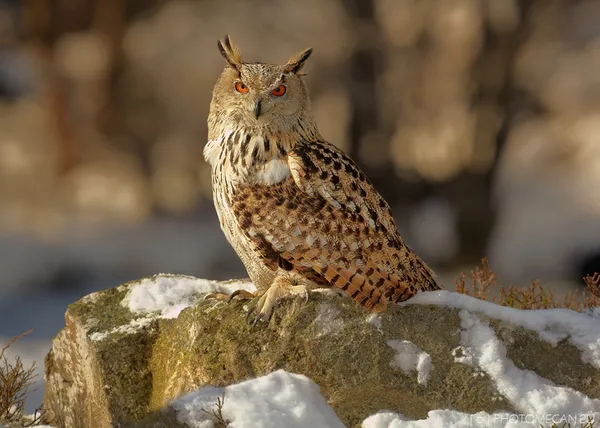
The Eurasian eagle-owl (Bubo bubo) is a species of eagle-owl, a type of bird that resides much over Eurasia. It is often just called the eagle-owl in Europe and Asia. It is one of the largest species of owl. Females can grow to a total length of 75 cm (30 in), with a wingspan of 188 centimetres (6 feet 2 inches). Males are slightly smaller. This bird has distinctive ear tufts, with upper parts that are mottled with darker blackish colouring and tawny. The wings and tail are barred. The underparts are a variably hued buff, streaked with darker colouring. The facial disc is not very defined. The orange eyes are distinctive. At least 12 subspecies of the Eurasian eagle-owl are described. Eurasian eagle-owls are found in many habitats; mostly mountainous and rocky areas, often near varied woodland edge and near shrubby areas with openings or wetlands. They also inhabit coniferous forests, steppes, and remote areas. Occasionally, they are found in farmland and in park-like settings in European and Asian cities and, very rarely, in busier urban areas. The eagle-owl is mostly a nocturnal predator. Predominantly, they hunt small mammals, such as rodents and rabbits, but also birds and larger mammals. Secondary prey include reptiles, amphibians, fish, large insects, and invertebrates. The species typically breeds on cliff ledges, in gullies, among rocks, and in other concealed locations. The nest is a scrape containing a clutch of 2–4 eggs typically, which are laid at intervals and hatch at different times. The female incubates the eggs and broods the young. The male brings food for her and for the nestlings. Continuing parental care for the young is provided by both adults for about five months. In addition to being one of the largest living species of owl, the Eurasian eagle-owl is also one of the most widely distributed. With a total range in Europe and Asia of about 51.4 million km2 (19.8 million sq mi) and a total population estimated to be between 100,000 and 500,000 individuals, the IUCN lists the bird's conservation status as being of least concern, although the trend is listed as decreasing. The vast majority of eagle-owls live in Continental Europe, Scandinavia, Russia (which is almost certainly where the peak numbers and diversity of race occurs), and Central Asia.
Also on this shelf
Canada lynx.
California interior chaparral and woodlands.
See also
Uncatalogued shelfText from Wikipedia; plate via Wikimedia Commons. Text CC BY-SA 4.0; plate freely licensed (see Commons). Source record. Images and catalogue data are reproduced from open-access collections.