Natural History
Great Black Swamp
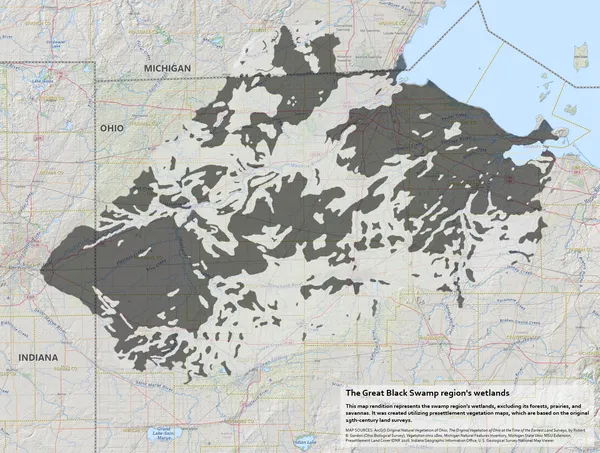
The Great Black Swamp (or Black Swamp) was a glacially fed wetland in northwest Ohio, northeast Indiana, and southeast Michigan that existed from the end of the Wisconsin glaciation until the late 19th century. Comprising extensive swamps and marshes interspersed with drier ground, it occupied what was formerly the southwestern part of proglacial Lake Maumee, a precursor to Lake Erie. It was the home of Indigenous nations for thousands of years until forced Indian removal in the early 19th century. The Ohio Department of Natural Resources stated the Great Black Swamp covered 3,072,000 acres (1,243,000 ha) and its Lake Erie marshes covered 300,000 acres (120,000 ha). Other estimates claim the wetlands covered 1,500 square miles (3,900 km2); or 2,600 square miles (6,700 km2); or were 140 miles (230 km) wide. Ohio has lost more than 90% of its wetlands, 60% of which were in the Great Black Swamp region. The swamp was drained between 1859 and 1885 to become highly productive farmland, enabling its eighteen counties in 2022 to generate over $3.2 billion from crop revenues and over $1 billion from livestock revenues. However, its agricultural runoff has degraded the environment. This causes frequent harmful algal blooms in Lake Erie. According to 19th-century land surveys and Geographic Information System (GIS) presettlement vegetation maps, the swamp existed within the Maumee, Ottawa, Portage, and Sandusky watersheds, and in the River Raisin's southern headwaters. Its boundary was determined by post-glacial landforms after glacial retreat thousands of years ago. The vast swamp was a mosaic of deciduous forests, wetlands, and prairies shaped by terrain and drainage. Lower elevations hosted swamps, with species such as ash, elm, cottonwood and sycamore. Marshes, fens, wet meadows, and wet prairies were also present, especially along the Lake Erie shoreline east of Toledo. Slightly higher elevations hosted mesic species such as beech, maple, basswood, and tuliptree. Dry ridges (moraines) hosted upland species like oak and hickory. Current wetlands such as the Okefenokee Swamp, the Great Dismal Swamp, the Atchafalaya Swamp, and the Everglades suggest the importance of the biodiversity within the ecosystems of the former Great Black Swamp region.
Also on this shelf
Geography of Australia.
Arignar Anna Zoological Park.
See also
Uncatalogued shelfText from Wikipedia; plate via Wikimedia Commons. Text CC BY-SA 4.0; plate freely licensed (see Commons). Source record. Images and catalogue data are reproduced from open-access collections.