Natural History
Bachitherium
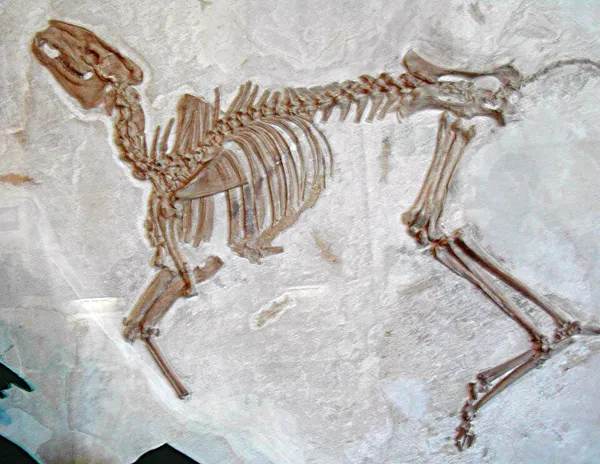
Bachitherium is an extinct genus of Paleogene ruminants that lived in Europe from the late Eocene to the late Oligocene. The genus was erected in 1882 by Henri Filhol based on fossil remains found in the Quercy Phosphorites Formation. Bachitherium curtum was defined the type species, and another species called B. insigne; five more species have since been named although one, B. sardus, is currently pending reassessment. The genus name derives from "Bach", the French locality where its first fossils were found, and the Greek θήρ/therium meaning "beast". Bachitherium has historically been assigned to various families within the ruminant infrorder Tragulina, but was reclassified to its own monotypic family Bachitheriidae by Christine Janis in 1987. For much of its taxonomic history, Bachitherium was only known from incomplete remains, making assessments difficult. However, a nearly complete skeleton of B. cf. insigne was uncovered in the commune of Céreste in France in 1981, which helped palaeontologists understand its morphology compared to other ruminants. The complete fossil revealed that Bachitherium had cursorial limb builds unlike typical tragulines and like smaller-sized members of the infraorder Pecora. In addition, its dentition differs from other traguline families such as the Tragulidae, Hypertragulidae, and Leptomerycidae by a combination of a tusklike but reduced bottom first incisor, strong upper canine, caniniform first bottom premolar, and other evolutionarily derived traits unique to the genus. Based on its dental and limb morphologies, B. curtum, weighing 7 kg (15 lb) to 8 kg (18 lb), was well-adapted to closed forest environments and ate a mix of leaves, fruit, and herbages. In comparison, the larger B. insigne, weighing up to 36 kg (79 lb), was more cursorial and therefore built for more open forested environments and a diet consisting mainly of leaves. The morphological differences between the species, combined with their frequent appearances in the same fossil deposits, imply niche partitioning based on their different ecological niches. The last species B. lavocati probably evolved from B.
Also on this shelf
Amphibian.
Breite Oak Tree Reserve.
See also
Uncatalogued shelfText from Wikipedia; plate via Wikimedia Commons. Text CC BY-SA 4.0; plate freely licensed (see Commons). Source record. Images and catalogue data are reproduced from open-access collections.