Natural History
Hamerkop
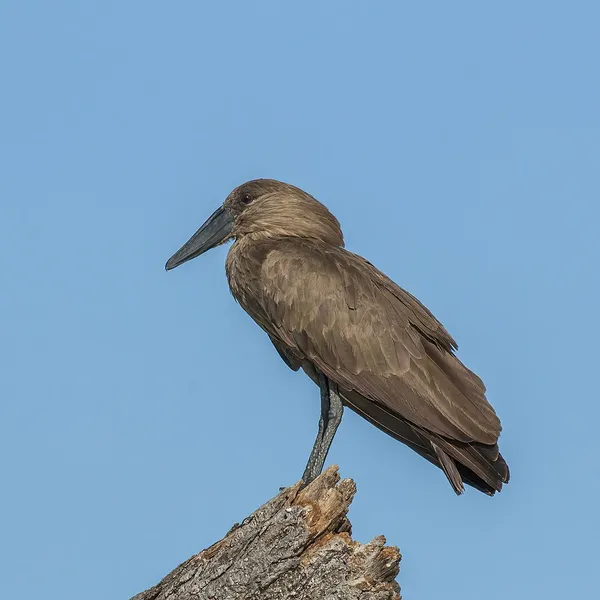
The hamerkop (Scopus umbretta), also called the umbrette, is a medium-sized water bird with brown plumage. It is found in mainland Africa, Madagascar and Arabia, living in a wide variety of wetlands, including estuaries, lakesides, fish ponds, riverbanks, and rocky coasts. The shape of its head, with its long bill and crest at the back, gives this species its name, hamerkop being the Afrikaans word for hammerhead. Long considered to sit with the Ciconiiformes, the species and its family is now placed with the Pelecaniformes, its closest relatives thought to be the pelicans and the shoebill. It is the only living species in the genus Scopus and the family Scopidae. The hamerkop is a sedentary bird that often shows local movements. Usually hunting in shallow water, either by sight or touch, it feeds mostly on fish and amphibians; however, the species is adaptable and will take any prey it can. The species is renowned for its enormous nests, several of which it builds during the breeding season. Unusually for a wading bird, the species constructs its nest with an internal nesting chamber where the eggs are laid. Both parents incubate the eggs and raise the chicks. The species is not globally threatened and is locally abundant in mainland Africa and Madagascar. The International Union for Conservation of Nature (IUCN) has assessed it as being of least concern.
Also on this shelf
Conservation in Angola.
Dzukou Valley.
See also
Uncatalogued shelfText from Wikipedia; plate via Wikimedia Commons. Text CC BY-SA 4.0; plate freely licensed (see Commons). Source record. Images and catalogue data are reproduced from open-access collections.