Natural History
Bayou
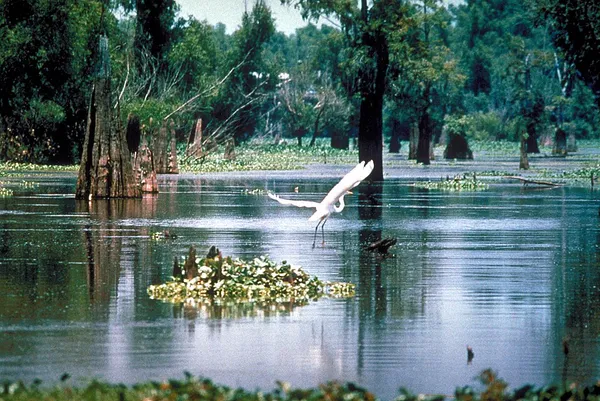
In usage in the Southern United States, a bayou ( ) is a body of water typically found in a flat, low-lying area. It may refer to an extremely slow-moving stream (often with a poorly defined shoreline), marshy lake, or wetland. They typically contain brackish water highly conducive to fish life and plankton. Bayous are commonly found in the Gulf Coast region of the southern United States, especially in the Mississippi River Delta, though they also exist elsewhere. A bayou is often an anabranch or minor braid of a braided channel that is slower than the main stem, usually becoming boggy and stagnant. Though fauna varies by region, many bayous are home to crawfish, certain species of shrimp, other shellfish, and leeches, catfish, frogs, toads, salamanders, newts, American alligators, turtles, and snakes such as watersnakes, swampsnakes, mudsnakes, crayfish snakes, and cottonmouths. Bayous are also home to semi-aquatic mammals such as beavers and river otters and land mammals such as white-tailed deer, black bears, bobcats, and raccoons. Common birds include anhingas, egrets, herons, spoonbills, as well as many other species. Taxodium (bald cypress) tends to be one of the dominant trees in bayous.
Also on this shelf
Fauna of Florida.
Fauna of Great Britain.
See also
Uncatalogued shelfText from Wikipedia; plate via Wikimedia Commons. Text CC BY-SA 4.0; plate freely licensed (see Commons). Source record. Images and catalogue data are reproduced from open-access collections.