Natural History
Fin whale
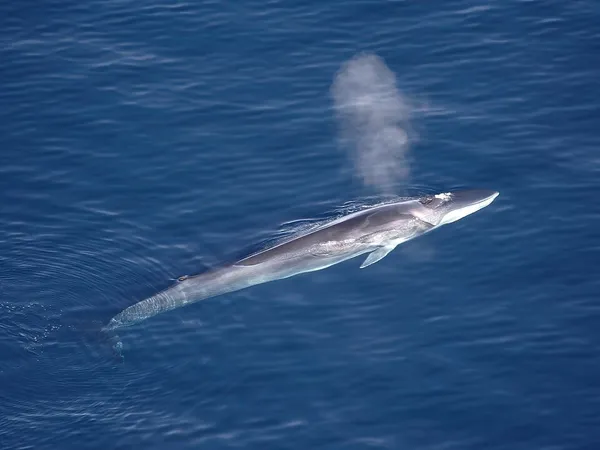
The fin whale (Balaenoptera physalus), also known as the finback whale or common rorqual, is a species of baleen whale and the second-longest cetacean after the blue whale. The biggest individual reportedly measured 26–27.3 m (85–90 ft) in length, with a maximum recorded weight of 65.5 to 120 t (64.5 to 118.1 long tons; 72.2 to 132.3 short tons). The fin whale's body is long, slender, and brownish-gray in color, with a paler underside to appear less conspicuous from below (countershading). At least two recognized subspecies exist, one in the North Atlantic and one across the Southern Hemisphere. The species is found in all the major oceans, from polar to tropical waters, and is absent only from waters close to the pack ice at the poles and relatively small areas of water away from the open ocean. The highest population density occurs in temperate and cool waters. Its prey mainly consists of smaller schooling fish, small squid, and crustaceans, including copepods and krill. Mating takes place in temperate, low-latitude seas during the winter. Fin whales are often observed in pods of 6–10 animals, with whom they communicate using frequency-modulated sounds, ranging from 16 to 40 hertz. Like all other large whales, the fin whale was a prized kill during the "heyday" of whaling from 1840 to 1861. This remained so into the 20th century, but decades of overharvesting contributed to declining numbers through the late 20th century. Over 725,000 fin whales were reportedly taken from the Southern Hemisphere between 1905 and 1976. Postrecovery numbers of the southern subspecies are predicted to be less than 50% of the pre-whaling population, even by 2010, due to long-lasting impacts of whaling and slow recovery rates. In the North Atlantic, it is considered to be fully recovered from past exploitation, while in other oceans, it is still in the process of recovery. As of 2018, it was assessed as vulnerable by the International Union for the Conservation of Nature.
Also on this shelf
Audubon National Wildlife Refuge.
Gaboon viper.
See also
Uncatalogued shelfText from Wikipedia; plate via Wikimedia Commons. Text CC BY-SA 4.0; plate freely licensed (see Commons). Source record. Images and catalogue data are reproduced from open-access collections.