Natural History
Brontosaurus
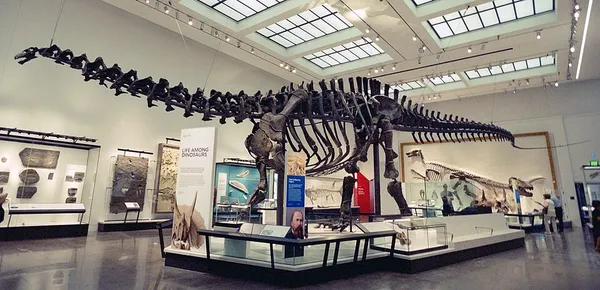
Brontosaurus ( BRON-tə-SOR-əs; literally 'thunder lizard', from the Greek words βροντή brontḗ, 'thunder', and σαῦρος saûros, 'lizard') is a genus of herbivorous sauropod dinosaur that lived in present-day United States during the Late Jurassic period. It was described by American paleontologist Othniel Charles Marsh in 1879, the type species being dubbed B. excelsus, based on a partial skeleton lacking a skull found in Como Bluff, Wyoming. In subsequent years, two more species of Brontosaurus were named: B. parvus in 1902 and B. yahnahpin in 1994. Brontosaurus lived about 156 to 146 million years ago (mya) during the Kimmeridgian and Tithonian ages in the Morrison Formation of what is now Utah and Wyoming. For decades, the animal was thought to have been a taxonomic synonym of its close relative Apatosaurus, but a 2015 study by Emmanuel Tschopp and colleagues found it to be distinct. It has seen widespread representation in popular culture, being the archetypal "long-necked" dinosaur in general media. The anatomy of Brontosaurus is well known, with fossils demonstrating that it was large, long-necked, and quadrupedal with a long tail terminating in a whip-like structure. The cervical vertebrae are notably extremely robust and heavily built, in contrast to its lightly built relatives Diplodocus and Barosaurus. The forelimbs were short and stout whereas the hindlimbs were elongated and thick, supported respectively by a heavily built shoulder girdle and pelvis. Several size estimates have been made, with the largest species B. excelsus reaching up to 21–23 m (69–75 ft) from head to tail and weighing in at 15–20 t (17–22 short tons), whereas the smaller B. parvus only got up to 19 m (62 ft) long. Juvenile specimens of Brontosaurus are known, with younger individuals growing rapidly to adult size in as little as 15 years. Brontosaurus has been classified within the family Diplodocidae, which was a group of sauropods that had shorter necks and longer tails compared to other families like brachiosaurs and mamenchisaurs. Diplodocids first evolved in the Middle Jurassic but peaked in diversity during the Late Jurassic with forms like Brontosaurus before becoming extinct in the Early Cretaceous. Brontosaurus is a genus in the subfamily Apatosaurinae, which includes only it and Apatosaurus, which are distinguished by their firm builds and thick necks.
Also on this shelf
Fauna of Bhutan.
Emperor penguin.
See also
Uncatalogued shelfText from Wikipedia; plate via Wikimedia Commons. Text CC BY-SA 4.0; plate freely licensed (see Commons). Source record. Images and catalogue data are reproduced from open-access collections.