Natural History
Alligator gar
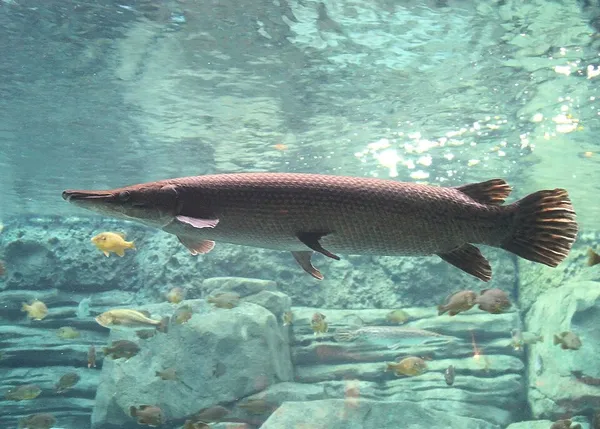
The alligator gar (Atractosteus spatula) is a euryhaline ray-finned fish in the clade Ginglymodi of the infraclass Holostei , being most closely related to the bowfins. It is the largest species in the gar family (Lepisosteidae), and is among the largest freshwater fishes in North America. The fossil record traces its group's existence back to the Early Cretaceous over 100 million years ago. Gars are often referred to as "primitive fishes" or "living fossils", because they have retained some morphological characteristics of their early ancestors, such as a spiral valve intestine, which is also common to the digestive system of sharks, and the ability to breathe in both air and water. Their common name was derived from their resemblance to the American alligator, particularly their broad snouts and long, sharp teeth. It is suggested that an alligator gar can grow up to 10 ft (3.0 m) in length. The body of an alligator gar is torpedo-shaped, usually brown or olive colored, fading to a lighter gray or yellow ventral surface. In very rare occurrences, they can also be black, seen in gars that have a high level of melanin. Their scales are not like the scales of other fishes; rather, they are ganoid scales, which are bone-like, rhomboidal-shaped scales, often with serrated edges, and covered by an enamel-like substance. Ganoid scales are nearly impenetrable, and are excellent protection against predation. Unlike other gar species, the upper jaw of an alligator gar has a dual row of large, sharp teeth that are used to impale and hold prey. Alligator gar are stalking, ambush predators, primarily piscivores, but they also ambush and eat waterfowl and small mammals they find floating on the water's surface. Populations of alligator gar have been extirpated from much of their historic range as a result of habitat destruction, indiscriminate culling, and unrestricted harvests. Populations are now located primarily in the southern portions of the United States extending into Mexico.
Also on this shelf
Hispid hare.
Geography of Australia.
See also
Uncatalogued shelfText from Wikipedia; plate via Wikimedia Commons. Text CC BY-SA 4.0; plate freely licensed (see Commons). Source record. Images and catalogue data are reproduced from open-access collections.