Natural History
Alvarezsauridae
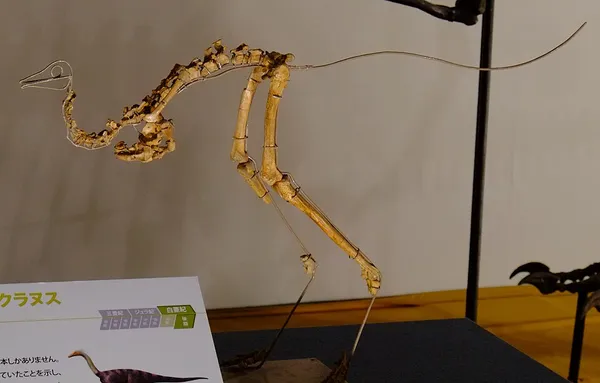
Alvarezsauridae is a family of small, long-legged dinosaurs. Although originally thought to represent the earliest known flightless birds, they are now thought to be an early diverging branch of maniraptoran theropods. Alvarezsaurids were highly specialized, with tiny, stout forelimbs ending in compact, bird-like hands. Their skeletons suggest that they had massive breast and arm muscles, possibly adapted for digging or tearing. They had long, tube-shaped snouts filled with tiny teeth. They have generally been interpreted as myrmecophagous, adapted to prey on colonial insects such as termites, with the short arms acting as effective digging instruments to break into nests. Alternative hypotheses of ovivory interpret the manus as specialized shell-cracking apparatuses, using the large claws and robust forelimbs to puncture eggs. Alvarezsaurus, the type genus of the family, was named after the historian and physician Gregorio Álvarez. Fossils attributed to alvarezsaurids have been found in North America, South America, and Asia, and range in age from about 86 to 66 million years ago.
Also on this shelf
Ezo flying squirrel.
Alcide d'Orbigny.
See also
Uncatalogued shelfText from Wikipedia; plate via Wikimedia Commons. Text CC BY-SA 4.0; plate freely licensed (see Commons). Source record. Images and catalogue data are reproduced from open-access collections.