Natural History
Geography of Iran
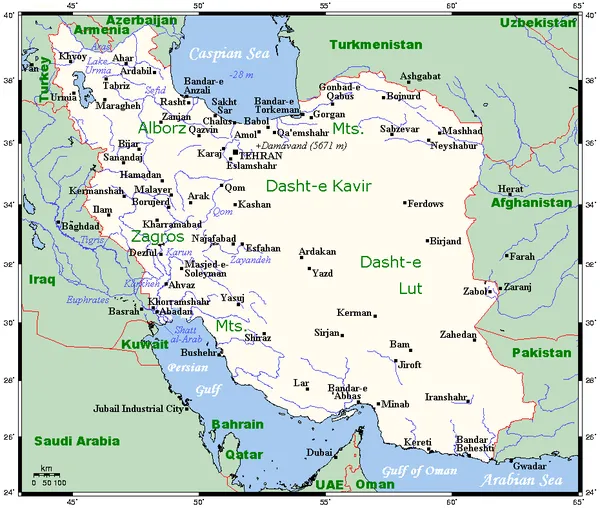
Geographically, the country of Iran is predominantly located on the Iranian plateau at the crossroads of West Asia and South Asia. Topographically, it borders the Caspian Sea, Persian Gulf, and Gulf of Oman. Its mountains have impacted both the political and the economic history of the country for several centuries. The mountains enclose several broad basins, on which major agricultural and urban settlements are located. Until the 20th century, when major highways and railroads were constructed through the mountains to connect the population centers, these basins tended to be relatively isolated from one another. Typically, one major town has dominated each basin, and there were complex economic relationships between the town and the hundreds of villages that surrounded it. In the higher elevations of the mountains rimming the basins, tribally organized groups practiced transhumance, moving with their herds of sheep and goats between traditionally established summer and winter pastures. There are no major river systems in the country, and historically transportation was by means of caravans that followed routes traversing gaps and passes in the mountains. The mountains also impeded easy access to the Persian Gulf and the Caspian Sea. With an area of 1,648,195 square kilometres (636,372 sq mi), Iran ranks seventeenth in size among the countries of the world. Iran shares its northern borders with several post-Soviet states: Armenia, Azerbaijan, and Turkmenistan. These borders extend for more than 2,000 kilometres (1,200 mi), including nearly 650 kilometres (400 mi) of water along the southern shore of the Caspian Sea. Iran's western borders are with Turkey in the north and Iraq in the south, terminating at the Arvand Rud. The Persian Gulf and Gulf of Oman littorals form the entire 1,770-kilometre (1,100 mi) southern border. To the east lie Afghanistan on the north and Pakistan on the far south. Iran's diagonal distance from the province of West Azerbaijan in the northwest to Sistan and Baluchestan province in the southeast is approximately 2,333 kilometres (1,450 mi).
Also on this shelf
List of Antillian and Bermudan species extinct in the Holocene.
Black-tufted marmoset.
See also
Uncatalogued shelfText from Wikipedia; plate via Wikimedia Commons. Text CC BY-SA 4.0; plate freely licensed (see Commons). Source record. Images and catalogue data are reproduced from open-access collections.