Natural History
Ferret
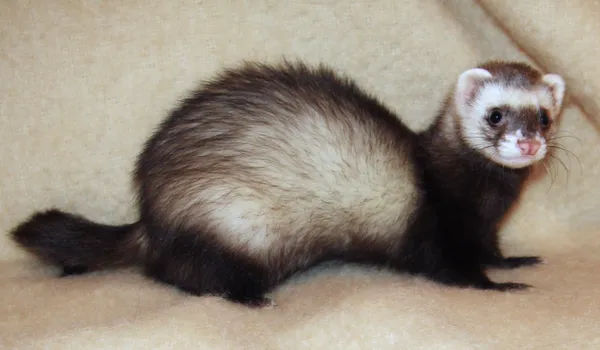
The ferret (Mustela furo) is a small, domesticated species belonging to the family Mustelidae. The ferret is most likely a domesticated form of the wild European polecat (Mustela putorius), as evidenced by the ferret's ability to interbreed with European polecats and produce hybrid offspring. Physically, ferrets resemble other mustelids because of their long, slender bodies. Including their tail, the average length of a ferret is about 50 cm (20 in); they weigh between 0.7 and 2.0 kg (1.5 and 4.4 lb); and their fur can be black, brown, white, or a mixture of those colours. The species is sexually dimorphic, with males being considerably larger than females. Ferrets may have been domesticated since ancient times, but there is widespread disagreement because of the sparseness of written accounts and the inconsistency of those which survive. Contemporary scholarship agrees that ferrets were bred for sport, hunting rabbits in a practice known as rabbiting. In North America, the ferret has become an increasingly prominent choice of household pet, with over five million in the United States alone. The legality of ferret ownership varies by location. In New Zealand and some other countries, restrictions apply due to the damage done to native fauna by feral colonies of polecat–ferret hybrids. The ferret has also served as a fruitful research animal, contributing to research in neuroscience and infectious disease, especially influenza. The domestic ferret is often confused with the black-footed ferret (Mustela nigripes), a species native to North America.
Also on this shelf
List of endangered animals in India.
Banded palm civet.
See also
Uncatalogued shelfText from Wikipedia; plate via Wikimedia Commons. Text CC BY-SA 4.0; plate freely licensed (see Commons). Source record. Images and catalogue data are reproduced from open-access collections.