Natural History
Deserts of Australia
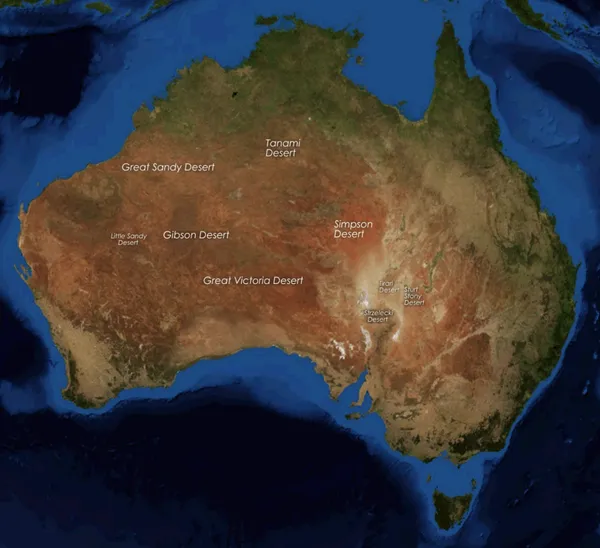
Deserts (primarily the Great Australian Desert) cover about 1,371,000 km2 (529,000 sq mi), or 18%, of the Australian mainland, but about 35% of the Australian continent receives so little rain that it is practically desert (other "deserts"). Collectively known as the Great Australian desert, they are primarily distributed throughout the Western Plateau and interior lowlands of the country, covering areas from South West Queensland, the Far West region of New South Wales and Spencer Gulf in South Australia to the Barkly Tableland in Northern Territory and the interior of Western Australia. Parts of the Mallee in Victoria are named as deserts; the region is described as semi-desert. By international standards, the Great Australian desert receives relatively high rates of rainfall, around 250 mm (10 in) on average, but due to the high evapotranspiration it would be correspondingly arid. No Australian weather stations situated in an arid region record less than 100 mm (3.94 in) of average annual rainfall. The deserts in the interior and south lack any significant summer rains. The desert in Western Australia is well explained by the little evaporation of the cold sea current of the West Australian Current, of polar origin, which prevents significant rainfall in the interior of the continent. About 40% of Australia is covered by dunes. Australia is the driest inhabited continent, with the least fertile soils. In addition to being mostly uninhabited, the Great Australian Desert is diverse, where it consists of semi-desert grassy or mountainous landscapes, xeric shrubs, salt pans, gibber (stony) deserts, red sand dunes, sandstone mesas, rocky plains, open tree savannahs and bushland with a few rivers and salt lakes, which are mostly seasonally dry and often have no outflow in the east. The 3 million km2 (1.2 million sq mi) desert is among the least modified in the world. The Australian desert has the largest population of feral camels in the world.
Also on this shelf
Bird intelligence.
Anoplotherium.
See also
Uncatalogued shelfText from Wikipedia; plate via Wikimedia Commons. Text CC BY-SA 4.0; plate freely licensed (see Commons). Source record. Images and catalogue data are reproduced from open-access collections.