Natural History
Falkland Islands wolf
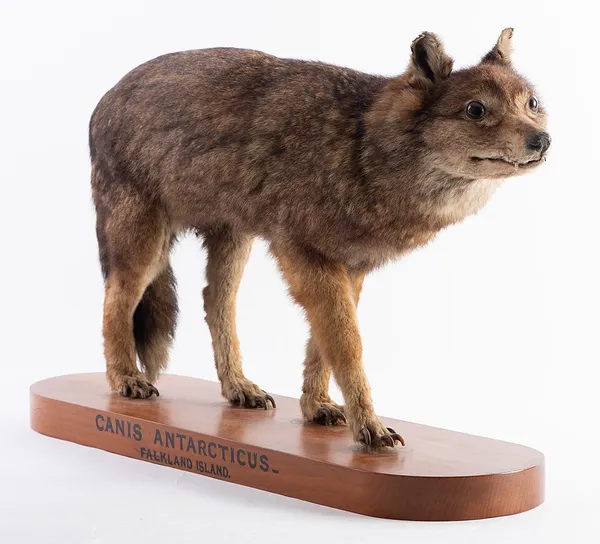
The Falkland Islands wolf (Dusicyon australis), also known as the warrah or the Falkland Islands fox, was the only native land mammal of the Falkland Islands. This endemic canid became extinct in 1876. It was once believed that the most closely related genus was South American fox (Lycalopex), including the culpeo, a fox-like mammal which was introduced to the Falkland Islands in modern times. A 2009 cladistic analysis of DNA identified the Falkland Islands wolf's closest living relative as the maned wolf (Chrysocyon brachyurus), an unusually long-legged, fox-like South American canid, from which it separated about 6.7 million years ago. However, the Falkland Islands wolf diverged from its mainland ancestor Dusicyon avus only around 16,000 years ago. Dusicyon avus persisted on the South American mainland until around 400 years ago. The Falkland Islands wolf existed on both West and East Falkland. Charles Darwin was uncertain if they were differentiated varieties or subspecies. Its fur had a tawny colour and the tip of the tail was white. Its diet is unknown, but without native rodents on the Falklands, the Falkland Islands wolf likely subsisted on seashore scavenging, ground-nesting birds, like geese and penguins, as well as seal pups and insects. It has been suggested they may have lived in burrows. Recent studies suggest it may have either naturally colonized the Falkland Islands or originate from domesticated Dusicyon avus brought to the islands by people before European settlers arrived.
Also on this shelf
Columbian ground squirrel.
Collared pika.
See also
Uncatalogued shelfText from Wikipedia; plate via Wikimedia Commons. Text CC BY-SA 4.0; plate freely licensed (see Commons). Source record. Images and catalogue data are reproduced from open-access collections.