Natural History
Hyrax
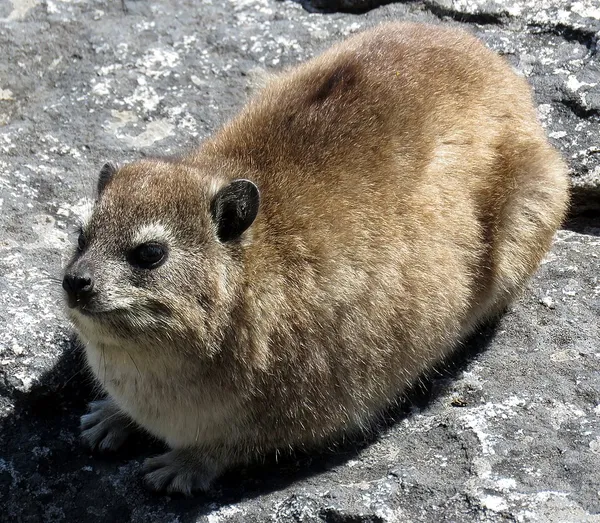
Hyraxes (from Ancient Greek ὕραξ hýrax 'shrew-mouse'), also called dassies, are small, stout, thickset, herbivorous mammals in the family Procaviidae within the order Hyracoidea. Hyraxes are well-furred, rotund animals with short tails. Modern hyraxes are typically between 30 and 70 cm (12 and 28 in) in length and weigh between 2 and 5 kg (4 and 11 lb). They are superficially similar to marmots or over-large pikas but are much more closely related to elephants and sirenians. Hyraxes have a life span of 9 to 14 years. Both types of "rock" hyrax (P. capensis and H. brucei) live on rock outcrops, including cliffs in Ethiopia and isolated granite outcrops called koppies in southern Africa. Almost all hyraxes are limited to Africa; the exception is the rock hyrax (P. capensis) which is also found in adjacent parts of the Middle East. Hyracoids were a much more diverse group in the past encompassing species considerably larger than modern hyraxes. The largest known extinct hyracoid, Titanohyrax ultimus, has been estimated to weigh 600–1,300 kilograms (1,300–2,900 lb), comparable to a water buffalo.
Also on this shelf
Brown County State Park.
Arthur Blayney Percival.
See also
Uncatalogued shelfText from Wikipedia; plate via Wikimedia Commons. Text CC BY-SA 4.0; plate freely licensed (see Commons). Source record. Images and catalogue data are reproduced from open-access collections.