Natural History
Cetacean
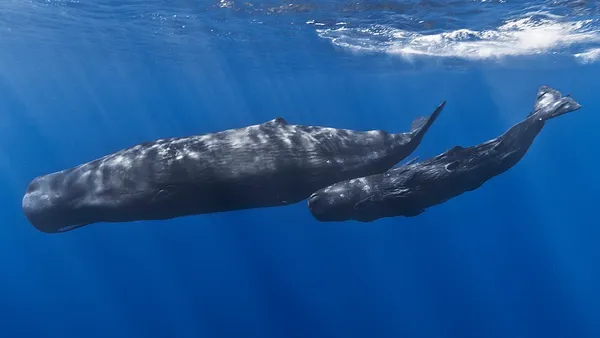
Cetaceans are marine mammals belonging to the infraorder Cetacea (), a secondarily aquatic clade under the order Artiodactyla that include whales, dolphins, porpoises and extinct groups such as Basilosaurus. Most cetaceans live in marine environments, particularly the pelagic zone, but some reside solely in brackish or fresh water. Having a cosmopolitan distribution, they can be found in some rivers and all of Earth's oceans. Many species migrate seasonally over vast ranges for food advantages. Key characteristics of cetaceans are their fully aquatic life cycle, streamlined, fish-like body shape, the need to periodically surface and breathe air, and exclusively carnivorous diet. Some cetaceans - the toothed whales - are capable of echolocation. As nektonic animals, cetaceans propel themselves through the water with powerful up-and-down movements of their tails, which have evolved into in a horizontal paddle-like fluke. Their hindlimbs have disappeared with only some vestigial skeleton of the pelvis and femurs, and their forelimbs have evolved into flippers which they use to paddle and steer. Some fast-swimming groups, most notably the smaller dolphins and porpoises, have a dorsal fin to facilitate directional stability. Cetaceans also have large brains and have high intelligence, complex social behaviour, and song-like communication. Some cetaceans have large bodies, such as the blue whale, which reaches a maximum confirmed length of 29.9 meters (98 feet) and a weight of 173 tonnes (190 short tons), making it the largest animal known to have existed. There are approximately 90 living cetacean species split into two parvorders: Odontoceti or toothed whales, which contains 75 species including porpoises, dolphins, the beaked whales and other predatory whales like the beluga and sperm whale, who prey upon fish, cephalopods and other marine mammals such as pinnipeds; and Mysticeti or baleen whales, which contains 15 species of large whales including the blue whale, humpback whale and bowhead whale among others, who are mostly filter-feeding planktivores (or sometimes bottom-feeding crustacivores or molluscivores, as in the case of the gray whale) using oral bristle plates known as baleen to sieve out and feed on large swarms of small invertebrates, usually crustaceans such as krill.
Also on this shelf
Amani Nature Reserve.
Cantareira State Park.
See also
Uncatalogued shelfText from Wikipedia; plate via Wikimedia Commons. Text CC BY-SA 4.0; plate freely licensed (see Commons). Source record. Images and catalogue data are reproduced from open-access collections.