Natural History
Dietary biology of the tawny owl
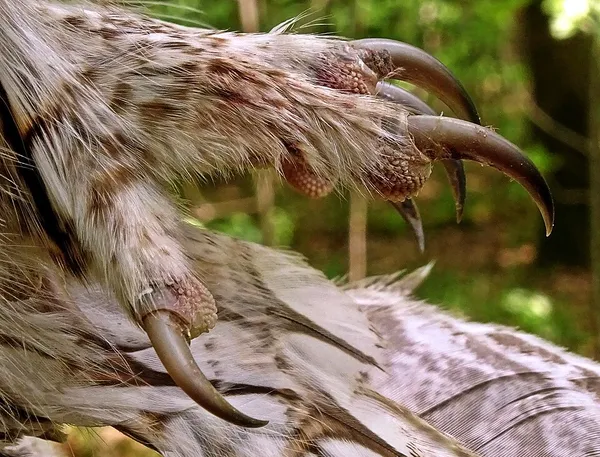
The tawny owl (Strix aluco) is an opportunistic and generalized predator. Peak hunting activity tends to occur largely between dusk to midnight, with owls often following an erratic hunting pattern, perhaps to sites where previous hunts were successful. When feeding young, hunting may need to be prolonged into daylight in the early morning. Based on hand-reared young owls that re-released into the wild, hunting behaviour is quite innate rather than learned. Normally this owl hunts from a perch. Perching bouts usually last from about 8 to 14 minutes depending largely on habitat. Tawny owl's hunting from a perch or pole can recall a buzzard and the two take similar prey sizes as well. However, high initial speed and maneuvering among trees and bushes with great dexterity may allow it to surprise relatively large prey, more like a goshawk. The tawny owl is capable of lifting and carrying off in flight individual prey weighing up to at least 320 g (11 oz). Their middle talon, the most enlarged claw on owls, measures an average of 19.1 mm (0.75 in). While not as large as those of the Ural owl, the talons are extremely sharp, stout and quite decurved. The claws are considered to be visibly more overdeveloped than those of other European mid-sized owls and the footspan including the claws is somewhat larger as well, at an average of about 13.4 cm (5.3 in). The hunting owl often extends its wings to balance and control prey upon impact. Alternatively, this species may hunt from flight. This occurs from 2 to 3 m (6.6 to 9.8 ft) over the ground, often over open habitats such as bushes, marsh or grassland, forming a quartering or zigzag pattern over the opening. During these flights they cover about 30 to 50 m (98 to 164 ft) before changing direction. Hunting from flight was surprisingly prevalent in a Swedish study of two radio-tagged birds, with 34% of study time spent hunting from flight while 40% of the study time was spent on hunting from a perch. In a similar study in England, less than 1% of time was spent hunting from flight. In a more deliberate variation of hunting from flight, the hunting owl may examine crags and nest boxes or also hover around prey roosts.
Also on this shelf
Freezeout Lake.
Corvidae.
See also
Uncatalogued shelfText from Wikipedia; plate via Wikimedia Commons. Text CC BY-SA 4.0; plate freely licensed (see Commons). Source record. Images and catalogue data are reproduced from open-access collections.