Natural History
Golden-crowned sifaka
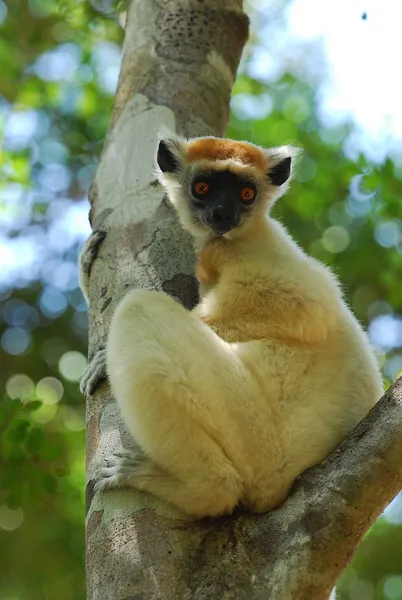
The golden-crowned sifaka or Tattersall's sifaka (Propithecus tattersalli) is a medium-sized lemur characterized by mostly white fur, prominent furry ears, and a golden-orange crown. It is one of the smallest sifakas (genus Propithecus), weighing around 3.5 kg (7.7 lb) and measuring approximately 90 cm (35 in) from head to tail. Like all sifakas, it is a vertical clinger and leaper, and its diet includes mostly seeds and leaves. The golden-crowned sifaka is named after its discoverer, Ian Tattersall, who first spotted the species in 1974. However, it was not formally described until 1988, after a research team led by Elwyn L. Simons observed and captured some specimens for captive breeding. The golden-crowned sifaka most closely resembles the western forest sifakas of the P. verreauxi group, yet its karyotype suggests a closer relationship with the P. diadema group of eastern forest sifakas. Despite the similarities with both groups, more recent studies of its karyotype support its classification as a distinct species. Found in gallery, deciduous, and semi-evergreen forest, its restricted range includes 44 forest fragments, totaling an area of 44,125 hectares (109,040 acres; 170.37 sq mi), centered on the town of Daraina in northeast Madagascar. Its estimated population is between 4,000 and 5,000 individuals. It is primarily active during the day, although it also tends to be active at dawn and dusk during the rainy season. It sleeps in tall emergent trees and is preyed upon by the fossa. The golden-crowned sifaka lives in groups of around five to six individuals, containing a balanced number of adult males and females. Scent is used to mark territories, which are defended by growling, chasing, and ritualistic leaping displays. Reproduction is seasonal, with gestation lasting six months and lactation lasting five months. Infants are weaned during the wet season to ensure the best chances of survival. The small range and fragmented populations of this species weigh heavily on its survival. Forest fragmentation, habitat destruction, poaching, slash-and-burn agriculture, and other human factors threaten its existence. The golden-crowned sifaka is listed by the IUCN Red List as Critically Endangered.
Also on this shelf
Asimina triloba.
Chocoyero-El Brujo Natural Reserve.
See also
Uncatalogued shelfText from Wikipedia; plate via Wikimedia Commons. Text CC BY-SA 4.0; plate freely licensed (see Commons). Source record. Images and catalogue data are reproduced from open-access collections.