Musical Instruments
"Heroes" (David Bowie song)
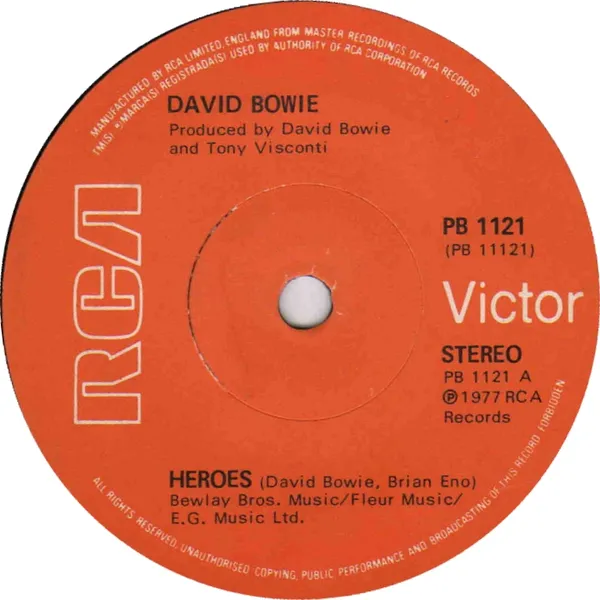
"'Heroes'" is a song by the English musician David Bowie from his 12th studio album of the same name. Co-written by Bowie and Brian Eno and co-produced by Bowie and Tony Visconti, the song was recorded in mid-1977 at Hansa Studio 2 in West Berlin. The backing track was recorded fully before the lyrics were written; Bowie and Eno added synthesiser overdubs while Robert Fripp contributed guitar. To record the vocals, Visconti devised a "multi-latch" system, in which three microphones were placed at different distances from Bowie and would open when he sang loudly enough. As with other album tracks, he improvised lyrics while standing at the microphone. An art rock song that builds throughout its run time, "'Heroes'" concerns two lovers, one each from East and West Berlin. Under constant fear of death, they dream they are free, swimming with dolphins. Bowie placed the title in quotation marks as an expression of irony on the otherwise romantic and triumphant words and music. Bowie's lyrics were primarily inspired by seeing Visconti and singer Antonia Maass kiss beside the Berlin Wall; other inspirations included a painting by Otto Mueller and a short story by Alberto Denti di Pirajno. Scholars have associated the song with Cold War Berlin, interpreting the divided city as a metaphor for personal struggles and Bowie's recovery from addiction. On 23 September 1977, the song was released as a single, shortened by two minutes and starting with the third verse. The song initially received mostly positive reviews, with some welcoming it as a classic addition to the artist's catalogue. Bowie promoted the song with a music video and sang it on numerous television programmes, including Marc Bolan's Marc and Bing Crosby's Merrie Olde Christmas special. Bowie also released German- and French-language versions of "'Heroes'", titled "'Helden'" and "'Héros'", respectively. Despite its heavy promotion, the song only peaked at number 24 on the UK Singles Chart, failed to chart at all on the US Billboard Hot 100 or the Canadian Top 100; however, it reached the top 10 and the top 20 in multiple European countries and Australia. Over time, the song's reputation has grown substantially; it is now widely considered one of Bowie's finest songs, and one of the greatest songs of all time. His biographers pan the edited single version for diminishing the song's power.
Also on this shelf
Handel solo sonatas (Walsh).
Elihu Yale.
See also
Uncatalogued shelfText from Wikipedia; plate via Wikimedia Commons. Text CC BY-SA 4.0; plate freely licensed (see Commons). Source record. Images and catalogue data are reproduced from open-access collections.