Musical Instruments
Ich will den Kreuzstab gerne tragen, BWV 56
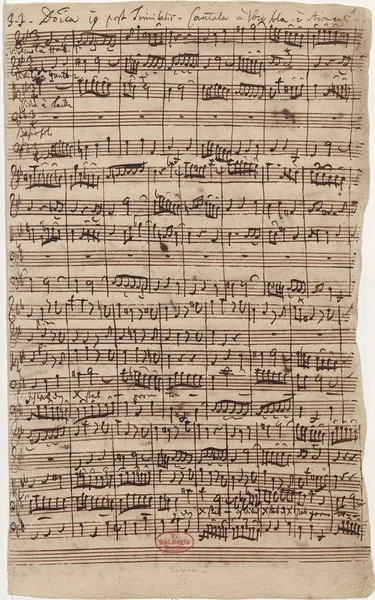
Ich will den Kreuzstab gerne tragen (lit. 'I will gladly carry the cross-staff'), BWV 56, is a church cantata composed by Johann Sebastian Bach for the 19th Sunday after Trinity. It was first performed in Leipzig on 27 October 1726. The composition is a solo cantata (German: Solokantate) because, apart from the closing chorale, it requires only a single vocal soloist (in this case a bass). The autograph score is one of a few cases where Bach referred to one of his compositions as a cantata. In English, the work is commonly referred to as the Kreuzstab cantata. Bach composed the cantata in his fourth year as Thomaskantor; it is regarded as part of his third cantata cycle. The text was written by Christoph Birkmann, a student of mathematics and theology in Leipzig who collaborated with Bach. He describes in the first person a Christian willing to "carry the cross" as a follower of Jesus. The poet compares life to a voyage towards a harbour, referring indirectly to the prescribed Gospel reading which says that Jesus travelled by boat. The person, at the end, yearns for death as the ultimate destination, to be united with Jesus. This yearning is reinforced by the closing chorale: the stanza "Komm, o Tod, du Schlafes Bruder" ('Come, O death, you brother of sleep') from Johann Franck's 1653 hymn "Du, o schönes Weltgebäude", which uses the imagery of a sea voyage. Bach structured it in five movements, alternating arias and recitatives for a bass soloist, and closing with a four-part chorale. He scored the work for a Baroque instrumental ensemble of three woodwind instruments, three string instrument parts and continuo. An obbligato cello features in the first recitative and an obbligato oboe in the second aria, resulting in different timbres in the four movements for the same voice part. The autograph score and the performance parts are held by the Berlin State Library. The cantata was published in 1863 in volume 12 of the Bach-Gesellschaft Ausgabe (BGA). The Neue Bach-Ausgabe (NBA) published the score in 1990.
Also on this shelf
Cedric Sharpe.
Darren Korb.
See also
Uncatalogued shelfText from Wikipedia; plate via Wikimedia Commons. Text CC BY-SA 4.0; plate freely licensed (see Commons). Source record. Images and catalogue data are reproduced from open-access collections.