Musical Instruments
Es erhub sich ein Streit, BWV 19
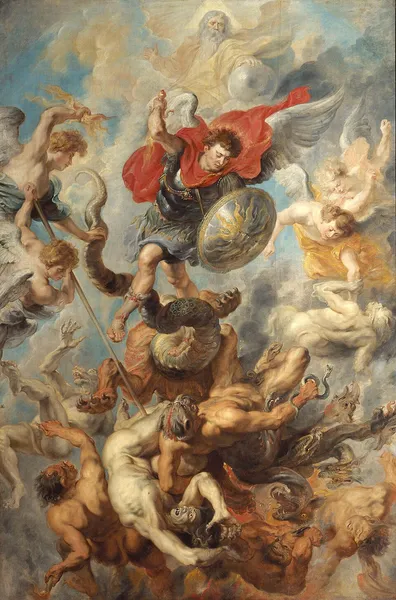
Es erhub sich ein Streit (There arose a war), BWV 19, is a church cantata by Johann Sebastian Bach. He composed it in Leipzig in 1726 for the Feast of Saint Michael and first performed it on 29 September that year. It is the second of his three extant cantatas for this feast, which also marked the start of an annual trade fair in Leipzig. Bach composed the cantata in his fourth year as Thomaskantor (director of church music) in Leipzig. The text was originally written by Picander and published in Leipzig in 1725. The expanded text that Bach actually used appeared in a 1728 cantata collection by Christoph Birkmann in Nuremberg. The cantata is structured in seven movements, with two choral movements framing a sequence of alternating recitatives and arias. The closing chorale is taken from a hymn by Christoph Demantius to the melody of "Freu dich sehr, o meine Seele". The cantata is scored for soprano, tenor and bass vocal soloists, a four-part choir, and a Baroque instrumental ensemble of three trumpets and timpani, three kinds of oboes, strings and basso continuo. The opening chorus begins with immediacy without an instrumental introduction and depicts in its opening and closing section an agitated battle. The cantata's longest movement is a tenor aria as a pensive response, to which a trumpet plays the complete melody of Martin Schalling's hymn "Herzlich lieb hab ich dich, o Herr". A chorale is in a dance-like triple meter closes the work. Bach's sons Wilhelm Friedemann Bach and Carl Philipp Emanuel Bach later performed parts of the cantata.
Also on this shelf
Andrew Parrott.
Eurovision Song Contest 1988.
See also
Uncatalogued shelfText from Wikipedia; plate via Wikimedia Commons. Text CC BY-SA 4.0; plate freely licensed (see Commons). Source record. Images and catalogue data are reproduced from open-access collections.