Musical Instruments
Eight Songs for a Mad King
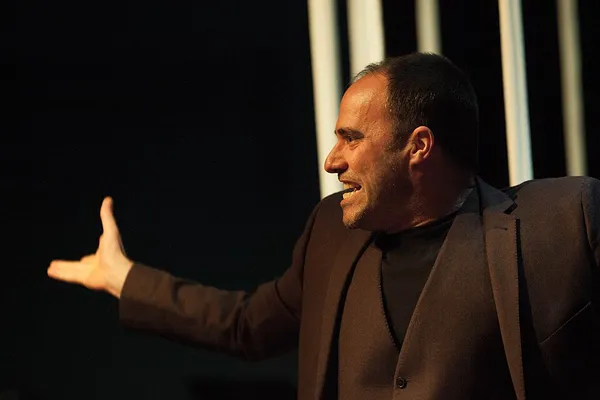
Eight Songs for a Mad King is a monodrama by Sir Peter Maxwell Davies with a libretto by Randolph Stow, based on words of George III. The work was written for the South-African actor Roy Hart and the composer's ensemble, the Pierrot Players. It was premiered on 22 April 1969. Lasting half an hour, it is scored for a baritone with an extraordinary command of extended vocal techniques covering more than five octaves, and six players (Pierrot ensemble + percussion): flute (doubling piccolo) clarinet percussion (1 player): railway whistle, snare drum, 2 suspended cymbals, foot cymbal, 2 wood blocks, 2 bass drums, chains, ratchet, tom-toms, tamtam, tambourine, rototoms, toy bird-calls, 2 temple blocks, wind chimes, crotales, sleigh bells, dulcimer, glockenspiel, steel bars, crow, didgeridoo, washboard piano (doubling harpsichord) violin cello Extended techniques are also required by the instrumentalists: for example there is frequent use of flutter-tonguing and multiphonics for the wind instruments and the pianist is required to play inside the piano with a plectrum. In the third song all the instrumentalists except the flautist play bird-calls and mechanical bird noises. Although most of the techniques are notated quite specifically, there are passages of guided improvisation, most obviously in the wind instruments at the end of the 5th song, when they are instructed to "use given pitches as centres around which groups — small, slow phrases, are built." Like its predecessor, Pierrot lunaire, different movements make use of different combinations from the ensemble. The full ensemble is used in the first, third, fifth, and seventh songs as well as the first transition. The second song omits the wind instruments; the fourth song omits the wind instruments, violin, and piano; the sixth song omits the flute (with the exception of the first, very short, chord); the second transition omits the baritone; the eighth song omits the violinist (as the instrument has been smashed by this point). The piece moves through a variety of different rhythmic characters. Some passages, such as the second transition, are strictly pulsed with a relatively clear metre (although extensive use of cross-rhythm), others use overlapping tempi (e.g.
Also on this shelf
Dizi (instrument).
Guqin.
See also
Uncatalogued shelfText from Wikipedia; plate via Wikimedia Commons. Text CC BY-SA 4.0; plate freely licensed (see Commons). Source record. Images and catalogue data are reproduced from open-access collections.