Musical Instruments
Concertina
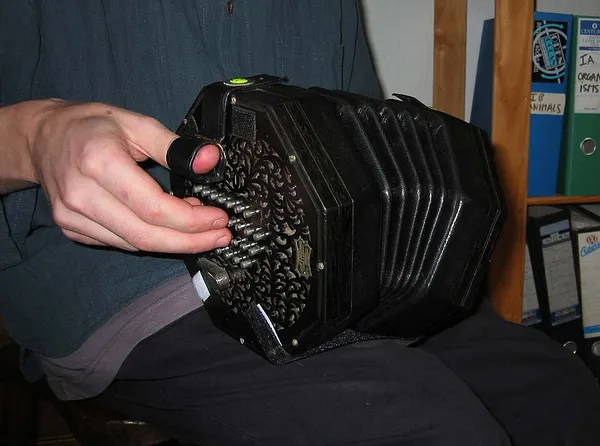
A concertina is a free-reed musical instrument, like the various accordions and the harmonica. It consists of expanding and contracting bellows, with buttons (or keys) usually on both ends, unlike accordion buttons, which are on the front. The concertina was developed independently in both England and Germany. The English concertina was invented in 1829 by Sir Charles Wheatstone, while Carl Friedrich Uhlig introduced the German concertina five years later, in 1834. Various forms of concertina are used for classical music; for the traditional music of Ireland, England, and South Africa; and for tango and polka music. Due to the concertina's small and compact size, it has historically been a common instrument among itinerants, such as soldiers, sailors, and cowboys. One was even brought aboard Robert Peary's expedition to Greenland in 1891–92. Despite its association with the Golden Age of Piracy in popular culture, it was invented roughly a century later.
Also on this shelf
Jean-Baptiste Vuillaume.
Kabir Sehgal.
See also
Uncatalogued shelfText from Wikipedia; plate via Wikimedia Commons. Text CC BY-SA 4.0; plate freely licensed (see Commons). Source record. Images and catalogue data are reproduced from open-access collections.