Musical Instruments
Du sollt Gott, deinen Herren, lieben, BWV 77
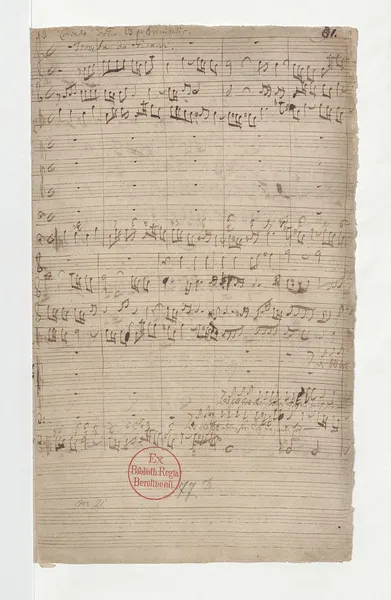
Johann Sebastian Bach composed the church cantata Du sollt Gott, deinen Herren, lieben (You shall love God, your Lord), BWV 77 in Leipzig for the thirteenth Sunday after Trinity and first performed it on 22 August 1723. Bach composed the cantata in his first year as Thomaskantor in Leipzig, where he had begun a first cantata cycle for the occasions of the liturgical year on the first Sunday after Trinity with Die Elenden sollen essen, BWV 75. The cantata text, written by Johann Oswald Knauer, is focused on the prescribed reading for the Sunday, the parable of the Good Samaritan containing the Great Commandment, which is used as the text of the first movement. A pair of recitative and aria deals with the love of God, while a symmetrical pair deals with the love of the neighbour. Bach did not write the text of the closing chorale in the score, but probably his son Johann Christoph Friedrich Bach. Bach scored the cantata for four vocal soloists, mixed choir, tromba da tirarsi, two oboes, strings and continuo. In the first movement Bach uses an instrumental quotation of Luther's hymn on the Ten Commandments, "Dies sind die heilgen zehn Gebot" (These are the holy ten commandments), played by the trumpet in canon with the continuo.
Also on this shelf
Auld Lang Syne.
Batá drum.
See also
Uncatalogued shelfText from Wikipedia; plate via Wikimedia Commons. Text CC BY-SA 4.0; plate freely licensed (see Commons). Source record. Images and catalogue data are reproduced from open-access collections.