Musical Instruments
Ancient Greek harps
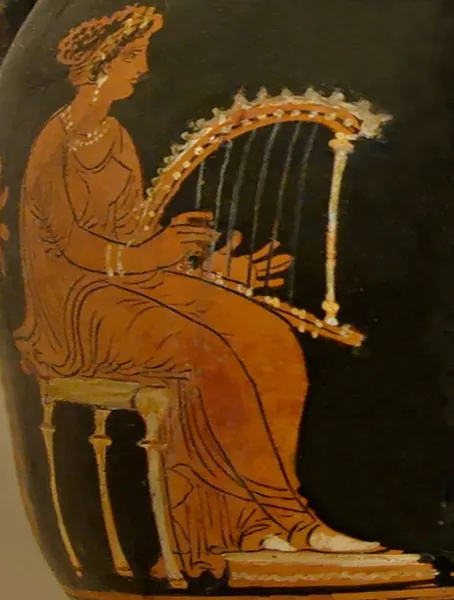
The psalterion (Greek ψαλτήριον) is a stringed, plucked instrument, an ancient Greek harp. Psalterion was a general word for harps in the latter part of the 4th century B.C. It meant "plucking instrument". In addition to their most important stringed instrument, the seven-stringed lyre, the Greeks also used multi-stringed, finger-plucked instruments: harps. The general name for these was the psalterion. Ancient vase paintings often depict – almost always in the hands of women – various types of harps. Names found in written sources include pektis, trigonos, magadis, sambuca, epigonion. These names could denote instruments of this type. Unlike the lyres, the harp was rarely used in Greece. It was seen as an "outside instrument" from the Orient. It also touched on Greek social mores, being used mainly by women, both upper-class women as well as hetaerae entertainers. There was a group of women known as psaltriai, female pluckers of the instrument who could be hired for parties. Anacreon, poet of drinking and love (and infatuation, disappointment, revelry, parties, festivals, and observations of everyday people), sang of playing the Lydian harp and pektis in his works. The "most important" harps were the psaltêrion, the mágadis and the pēktis. The Latin equivalent of the word, psalterium, has been the name of many-stringed box zithers or board zithers since the Middle Ages.
Also on this shelf
Classical Discoveries.
Charles Ives House.
See also
Uncatalogued shelfText from Wikipedia; plate via Wikimedia Commons. Text CC BY-SA 4.0; plate freely licensed (see Commons). Source record. Images and catalogue data are reproduced from open-access collections.