Musical Instruments
Hula
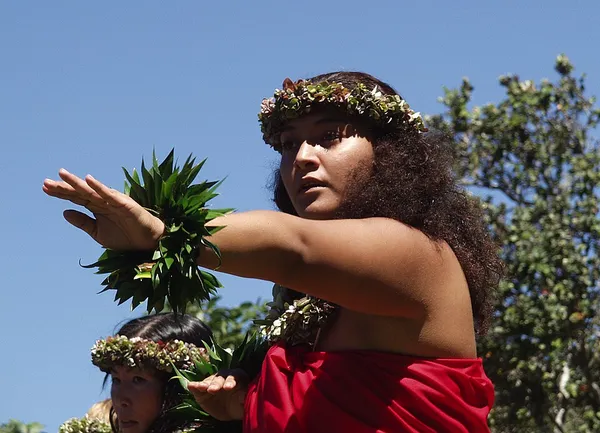
Hula () is a Hawaiian dance form expressing song (mele). It was developed in the Hawaiian Islands by the Native Hawaiians who settled there. The hula dramatizes or portrays the words of the mele in a visual dance form. There are many sub-styles of hula, with the two main categories being hula ʻauana and hula kahiko. Ancient hula, performed before Western encounters with Hawaiʻi, is called kahiko. It is accompanied by chant and traditional instruments. Hula, as it evolved under Western influence in the 19th and 20th centuries, is called ʻauana (a word that means "to wander" or "drift"). It is accompanied by song and Western-influenced musical instruments such as the guitar, the ʻukulele, and the double bass. Terminology for two additional categories is beginning to enter the hula lexicon: "Monarchy" includes any hula which were composed and choreographed during the 19th century. During that time the influx of Western culture created significant changes in the formal Hawaiian arts, including hula. "Ai Kahiko", meaning "in the ancient style" are those hula written in the 20th and 21st centuries that follow the stylistic protocols of the ancient hula kahiko. There are also two main positions of a hula dance: either sitting (noho dance) or standing (luna dance). Some dances utilize both forms. Hula dancing is complex, with many hand motions used to represent the words in a song or chant. For example, hand movements can signify aspects of nature, such as the swaying of a tree in the breeze or a wave in the ocean, or a feeling or emotion, such as fondness or yearning. Foot and hip movements often pull from a basic library of steps including the kāholo, kaʻo, kāwelu, hela, ʻuwehe, and ʻami. There are other related dances (tamure, hura, 'aparima, 'ote'a, haka, kapa haka, poi, Fa'ataupati, Tau'olunga, and Lakalaka) that come from other Polynesian islands such as Tahiti, The Cook Islands, Samoa, Tonga and New Zealand; however, the hula is unique to the Hawaiian Islands. Five hula genres can be placed across a spectrum with "the most ancient" on the left and "the most modern" on the right side. The Hula pahu and hula 'āla'apapa subcategories are ancient, originating before the introduction of Christianity. Thanks to well-preserved documentation, guidelines for performers to bring the poetic text back on stage remain clear in manuscript sources.
Also on this shelf
Church music in Scotland.
Alexander Tcherepnin.
See also
Uncatalogued shelfText from Wikipedia; plate via Wikimedia Commons. Text CC BY-SA 4.0; plate freely licensed (see Commons). Source record. Images and catalogue data are reproduced from open-access collections.