Musical Instruments
Gourd mouth organ
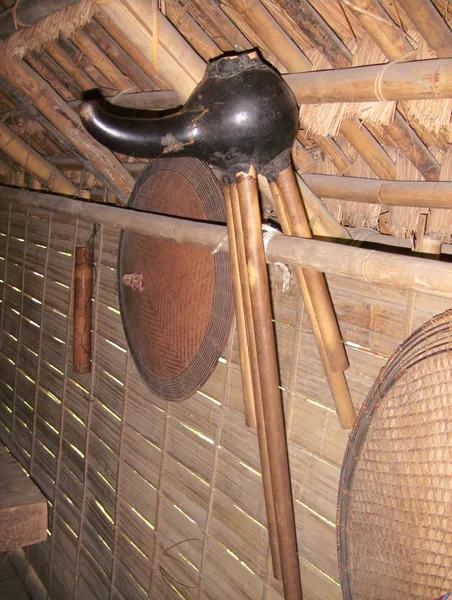
The gourd mouth organ is a free reed mouth organ played across East and Southeast Asia. It consists of a gourd wind chest with several bamboo or bronze pipes inserted on top of it, the numbers of pipes differing from region to region. The gourd mouth organ is closely associated with cultural minorities in Asian countries; thus, its styles are diverse, and different counterparts can be seen across different cultures. In southern China, the generic name of the gourd mouth organ is Hulu Sheng (Chinese: 葫芦笙; pinyin: húlúshēng; lit. 'gourd sheng'). The accompaniment of the instrument is essential to the ethnic minorities in China's southern province of Yunnan, such as the Lahu, Yi, Miao and Naxi, especially during their ritual Tage dancing. In southeast Asia, like Upper Myanmar, northern Laos, northeast Thailand, and Rattanakiri province in Cambodia, the gourd mouth organ is also an essential part of the people's daily and ceremonial lives. In Thailand, it is called naw among the Lahu, lachi among the Akha, and fulu among the Lisu; in Cambodia, it is called ploy; in northeastern Borneo, it is called sumpoton; and in Laos, Myanmar, Vietnam and Bangladesh, it is called đing nǎm or m'buot. The gourd mouth organ is tuned based on the pentatonic scale without semitones, especially in the melodies, and the melodies are usually accompanied by chords. Pitches can be changed by closing and opening the pipe holes. The players hold the instrument almost horizontally and blow into the windchest during aspiration.
Also on this shelf
Brazilian Carnival.
Antonín Dvořák.
See also
Uncatalogued shelfText from Wikipedia; plate via Wikimedia Commons. Text CC BY-SA 4.0; plate freely licensed (see Commons). Source record. Images and catalogue data are reproduced from open-access collections.