Musical Instruments
Buddy Holly
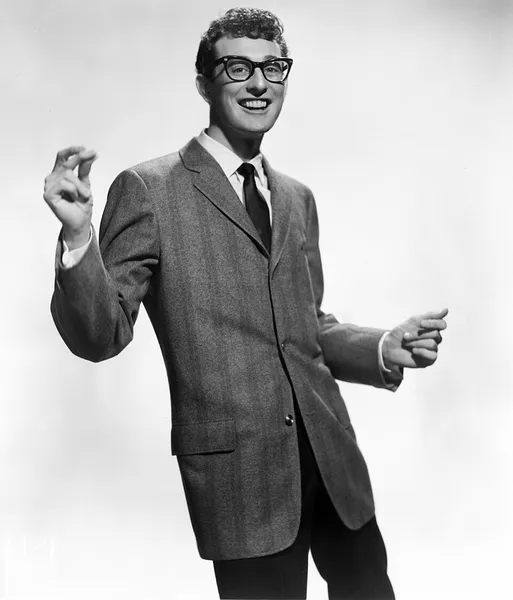
Charles Hardin Holley (September 7, 1936 – February 3, 1959), known professionally by his stage name Buddy Holly, was an American singer, songwriter, and guitarist who was a central and pioneering figure of rock and roll. He was born to a musical family in Lubbock, Texas, during the Great Depression, and learned to play guitar and sing alongside his two siblings. Holly made his first appearance on local television in 1952, and the following year he formed the group Buddy and Bob with his friend Bob Montgomery. In 1955, after opening once for Elvis Presley, Holly decided to pursue a music career. He played with Presley three times that year, and his band's style shifted from country and western to rock and roll. In October that year, when Holly opened for Bill Haley & His Comets, he was spotted by Nashville scout Eddie Crandall, who helped him get a contract with Decca Records. Holly's recording sessions at Decca were produced by Owen Bradley, who had become famous for producing orchestrated country hits for stars like Patsy Cline. Unhappy with Bradley's musical style and control in the studio, Holly went to producer Norman Petty in Clovis, New Mexico, and recorded a demo of "That'll Be the Day", among other songs. Petty became the band's manager and sent the demo to Brunswick Records, which released it as a single credited to the Crickets, a name chosen by the band to subvert Decca's contract limitations. In September 1957, as the band toured, "That'll Be the Day" topped the US and UK singles charts. Its success was followed in October by another major hit, "Peggy Sue". The album The "Chirping" Crickets, released in November 1957, reached number five on the UK Albums Chart. Holly made his second appearance on The Ed Sullivan Show in January 1958 and soon after toured Australia and then the UK. In early 1959, he assembled a new band, consisting of Waylon Jennings (bass), Tommy Allsup (guitar), and Carl Bunch (drums), and embarked on a tour of the midwestern US. After a show in Clear Lake, Iowa, Holly chartered an airplane to travel to his next show in Moorhead, Minnesota. Soon after takeoff, the plane crashed, killing Holly, Ritchie Valens, the Big Bopper, and pilot Roger Peterson in a crash later referred to by Don McLean as "The Day the Music Died" in his song "American Pie". During his short career, Holly wrote and recorded many songs.
Also on this shelf
Balaban (instrument).
Carmen Miranda.
See also
Uncatalogued shelfText from Wikipedia; plate via Wikimedia Commons. Text CC BY-SA 4.0; plate freely licensed (see Commons). Source record. Images and catalogue data are reproduced from open-access collections.