Musical Instruments
Baritone horn
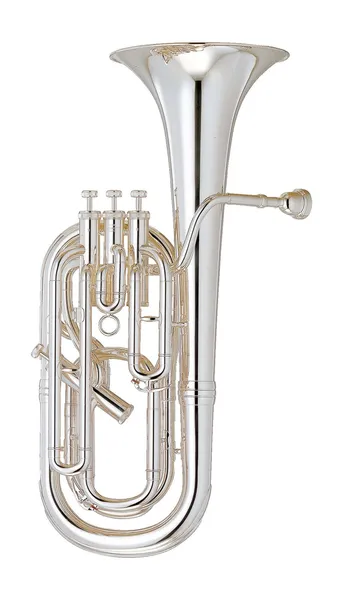
The baritone horn, or often simply the baritone, is a valved brass instrument pitched in B♭ in the saxhorn family, employed chiefly in brass, military and concert bands. In North America, for most of the 20th century, the term baritone also referred to similar instruments with a wider bore closer to the euphonium. The baritone has three or sometimes four piston valves, although rotary valves are common in Eastern and Central Europe, where it is called the Tenorhorn. The bore is moderately conical, like the E♭ tenor horn and cornet, although narrower than the euphonium and other valved bugles, like the flugelhorn and tuba. It uses a wide-rimmed cup mouthpiece of similar dimensions to trombone and euphonium mouthpieces. Like the trombone and the euphonium, the baritone can be considered either a transposing instrument reading B♭ treble clef or a non-transposing instrument in bass clef. In British brass bands, the standard instrumentation includes parts for two baritones in addition to two euphoniums. In US concert band music, there is often a part marked baritone, but these parts are commonly intended for, and played on, the euphonium. A baritone can also play music written for a trombone due to similarities in timbre and range.
Also on this shelf
Jan Savitt.
Eurovision Song Contest 2017.
See also
Uncatalogued shelfText from Wikipedia; plate via Wikimedia Commons. Text CC BY-SA 4.0; plate freely licensed (see Commons). Source record. Images and catalogue data are reproduced from open-access collections.