Musical Instruments
Claviorgan
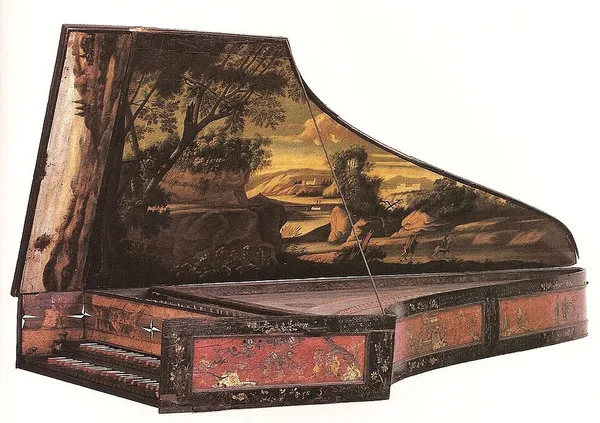
The claviorgan (also known as the claviorganum, claviorgano, clavecin organisee) is a combination of a stringed instrument (usually a keyboard instrument) and an organ. Its origin is uncertain, but its history can be traced back to the fifteenth century. According to one account, the instrument was invented by the Moorish instrument maker Mahoma Mofferiz, with his earliest known example documented in 1479. Other "Clabiorganos" or "claui organos" are documented in Spain by the year 1500, and the instrument seems to have spread from there. A number of "virgynalls with regals" are mentioned in the inventories of Henry VIII in 1542/3 and 1547 and Wilson Barry cites references to the claviorganum in England dating back to the 1530s. The term claviorgan in its strictest sense refers to the combination of a harpsichord (or other harpsichord type instrument) and an organ, although later could also be used to refer to a combination of a piano and organ. Michael Praetorius describes the claviorgan in his Syntagma Musicum of 1619 as: a clavicymbal, or some other symphony, in which a number of pipes is combined with the strings. Externally it looks exactly like a clavicymbal or symphony, apart from the bellows, which are sometimes set at the rear and sometimes placed inside the body
Also on this shelf
Dinah Washington.
John Playford.
See also
Uncatalogued shelfText from Wikipedia; plate via Wikimedia Commons. Text CC BY-SA 4.0; plate freely licensed (see Commons). Source record. Images and catalogue data are reproduced from open-access collections.