Musical Instruments
Citole
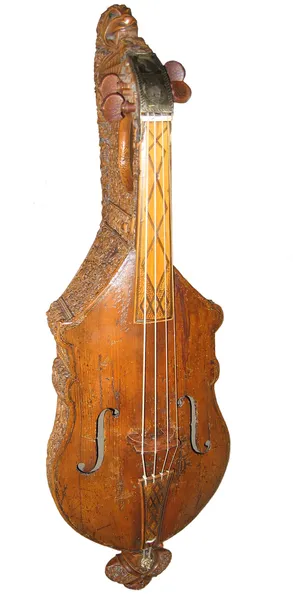
The citole was a string musical instrument, closely associated with the medieval fiddles (viol, vielle, gigue) and commonly used from 1200–1350. It was known by other names in various languages: cedra, cetera, cetola, cetula, cistola, citola, citula, citera, chytara, cistole, cithar, cuitole, cythera, cythol, cytiole, cytolys, gytolle, sitole, sytholle, sytole, and zitol. Like the modern guitar, it was manipulated at the neck to get different notes, and picked or strummed with a plectrum (the citole's pick was long, thick, straight and likely made of ivory or wood). Although it was largely out of use by the late 14th century, the Italians "re-introduced it in modified form" in the 16th century as the cetra (cittern in English), and it may have influenced the development of the guitar as well. It was also a pioneering instrument in England, introducing the populace to necked, plucked instruments, giving people the concepts needed to quickly switch to the newly arriving lutes and gitterns. Two possible descendant instruments are the Portuguese guitar and the Corsican Cetera, both types of cittern. It is known today mainly from art and literary sources. Early examples include Provençal poetry (there called the citola) from the 12th century; however it was more widely displayed in medieval artwork during the 13th and 14th centuries in manuscript miniatures and in sculpture. The art did not show uniformly shaped instrument, but instead an instrument with numerous variations. The variety shown in art has led the instrument to be called "ambiguous". From the artwork, scholars know that it was generally a four-string instrument, and could have anything from a "holly-leaf" to a rounded guitar shaped body (that can be called a "T-shaped" body). While paintings and sculpture exist, only one instrument has survived the centuries. The sole survivor, associated with Warwick Castle, was made around 1290–1300. It is now preserved in the British Museum's collection. At some point, probably in the sixteenth century, it was converted into a violin-type instrument with a tall bridge, 'f'-holes and angled fingerboard; thus, the instrument's top is not representative of its original appearance. That instrument contributed to a great deal of confusion. It was labeled a violin in the 18th century, a gittern in the early 20th century and finally a citole, beginning after 1977.
Also on this shelf
China cymbal.
Bochum.
See also
Uncatalogued shelfText from Wikipedia; plate via Wikimedia Commons. Text CC BY-SA 4.0; plate freely licensed (see Commons). Source record. Images and catalogue data are reproduced from open-access collections.